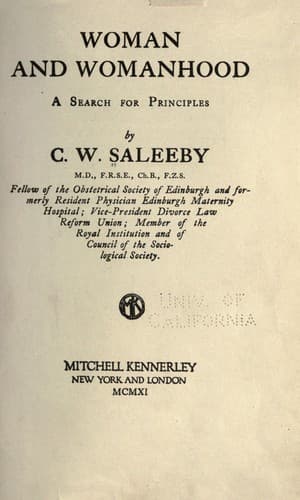
Woman and Womanhood: A Search for PrinciplesSaleeby, C. W. (Caleb Williams)
Science
Woman and Womanhood: A Search for Principles
Saleeby, C. W. (Caleb Williams)
Eugenics; Women
It is our business, then, to provide the spiritual environment in which
the maternal instinct is favoured and seen to be supremely honourable.
If in the "best" girls' schools ideas of marriage and babies are
ridiculed, the sooner these schools be rubbed down again into the soil,
the better. There is no need to substitute one form of cant for
another, but it is possible--possible even though the head-mistress
should be a spinster, for whom physical motherhood has not been and
never will be--to incorporate in the very spirit of the school, as part
of its public opinion, no less potent though its power be not
consciously felt, the ideals of real and complete womanhood, which mean
nothing less than the consecration of the individual to the future, and
the belief that such consecration serves not only the future but also
the highest satisfaction of her best self.
If it were our present task to define and specify the details of a
school in which girls should be educated for womanhood, for motherhood,
and the future, it would not be difficult, I think, to show how the
services of painting and sculpture, of poetry and prose, should be
enlisted. A word or two of outline may be permitted.
There is, for instance, a noble Madonna of Botticelli which is supremely
great, not because of the skill of the painter's hand, nor yet the
delicacy of his eye, but because of the spirit which they express.
Botticelli speaks across the centuries, and is none other than an
earlier voice uttering the words of Coleridge, teaching that a mother is
the holiest thing alive. The master may or may not have perceived that
the Madonna was a symbol; that what he believed of one holy mother was
worth believing just in so far as it serves to make all motherhood holy
and all men servants thereof. The painter can scarcely have looked at
his model and appreciated her fitness for his purpose without realizing
that he was concerned with depicting a truth not local and unique, but
universal and commonplace. Whether or not the painter saw this, we have
no excuse for not seeing it. Copies of such a painting as this should be
found in every girls' school throughout the world.
Public-domain text, read in full here on John Shaqi.
Reviews
Reviews
No reviews yet
Be the first to share your thoughts on this work.
Elsewhere in the archive
Join the Discussion
Join the discussion
Sign in to leave a comment or review.
Sign InorCreate an account