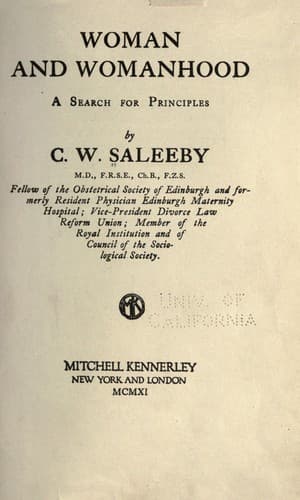
Woman and Womanhood: A Search for PrinciplesSaleeby, C. W. (Caleb Williams)
Science
Woman and Womanhood: A Search for Principles
Saleeby, C. W. (Caleb Williams)
Eugenics; Women
If we are in any measure to gain, by means of books, our end of forming
right ideals in the girl's mind, I am certain that we must not expect to
accomplish much with the help of any but very great writers. We may very
well doubt the substantial value for the purpose of anything written for
the purpose. Such books may be of value for the teacher; they may
possibly be of value in disposing of curiosity that has become
overweening or even morbid, but their value as preachments I much
question. The kind of writing upon which the young girl's mind will be
nourished in years to come is best represented by the lecture on
"Queens' Gardens" in Ruskin's "Sesame and Lilies," though in that
magnificent and immortal piece of literature there is nowhere any direct
allusion to motherhood as the natural ideal for girlhood. Yet if only
one girl in a hundred who read that lecture can be persuaded, in the
beautiful phrase to be found there, that she was "born to be love
visible," how excellent is the work that we shall have accomplished! A
chapter might well be devoted entirely to the teaching of Wordsworth
regarding womanhood. We need scarcely remind ourselves that this great
poet owed an immeasurable debt to his sister, and in lesser, though very
substantial, degree to his wife and daughters. He has left an abundance
of poetry which testifies directly and indirectly to these influences.
This poetry is not only utterly lovely as poetry; at once sane and
passionate, steadying and thrilling, but it is also not to be surpassed,
I cannot but believe, as a means for rightly forming the ideals of
girlhood. Every year sees an inundation of new collections of poetry.
The anthologist might do worse than collect from Wordsworth a small, but
precious and quintessential volume under some such title as "Wordsworth
and Womanhood." One would do it oneself but that literary people of a
certain school regard it as an impertinence that any one who believes in
knowledge should intrude into their sphere. Wordsworth, it is true, said
that "poetry is the breath and finer spirit of all knowledge; it is the
impassioned expression which is in the countenance of all Science." But
most literary people are so busy writing that they have no time to read,
and they forget these sayings of the immortal dead. Yet that is just a
saying which directly bears upon the present contention. We must be very
careful lest we insult and outrage girlhood with our physiology, not
that physiology is either insolent or outrageous, but that girlhood is
girlhood. It is the "breath and finer spirit" of our knowledge of sex
and parenthood that we must seek to impart to her. Poetry is its
vehicle, and the time will come when we shall consciously use it for
that great purpose.
Public-domain text, read in full here on John Shaqi.
Reviews
Reviews
No reviews yet
Be the first to share your thoughts on this work.
Elsewhere in the archive
Join the Discussion
Join the discussion
Sign in to leave a comment or review.
Sign InorCreate an account