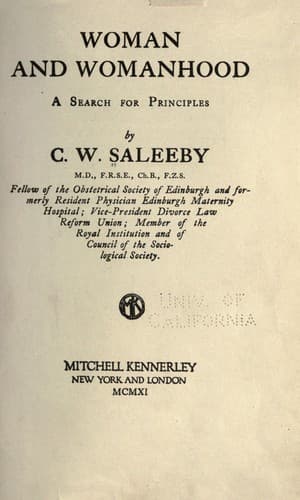
Woman and Womanhood: A Search for PrinciplesSaleeby, C. W. (Caleb Williams)
Science
Woman and Womanhood: A Search for Principles
Saleeby, C. W. (Caleb Williams)
Eugenics; Women
In my volume introductory to Eugenics I have dealt at length with
marriage from that point of view. Here our concern is with the
individual woman, and though neither in theory nor in practice can we
entirely dissociate the question of the future from that of the
individual's needs, it is necessary here to discuss the present
conditions of marriage in the civilized world, from the woman's point of
view. We have to ask ourselves how these conditions act in selecting
women from the ranks of the unmarried; whether the transition proceeds
from random chance, or whether there is a selection in certain definite
directions, and if so, what directions? We have to ask whether different
women would pass into the ranks of the married if the conditions of
marriage were other than they are; and we shall assuredly arrive at the
principle that whatever changes are necessary in the conditions of
marriage, so that the best women shall become the mothers of the future,
must be and will be effected.
One has elsewhere argued at length that monogamy is the marriage form
which has prevailed and will be maintained because of its superior
survival-value--in other words, because it best serves the interests of
the future. But what of the individual in a country where there are
thirteen hundred thousand adult women in excess of men, which is the
case of Great Britain? Plainly, there is need for very serious criticism
of such an institution in such circumstances. Let the reader briefly be
reminded, then, that, as I have previously argued, Nature makes no
arrangement for such a disproportion between the sexes. More boys than
girls are indeed born, but from our infantile mortality, which is
largely a male infanticide, onwards, morbid influences are at work which
result in the disproportion already named.
Two excellent reasons may be adduced why any disproportion in the
numbers of the sexes should be the opposite of that which now obtains.
The ideal condition, no doubt, is that of numerical equality. Failing
that, the evils of a male preponderance, though very real, are
comparatively small. For one thing, celibacy affects a woman more than a
man: men, on the whole, suffer less from being unmarried. It is a more
serious deprivation for the woman than for the man, in general, to be
debarred from parenthood. This is a proposition which we need not labour
here, for no reader will dispute its importance and its relevance.
Public-domain text, read in full here on John Shaqi.
Reviews
Reviews
No reviews yet
Be the first to share your thoughts on this work.
Elsewhere in the archive
Join the Discussion
Join the discussion
Sign in to leave a comment or review.
Sign InorCreate an account