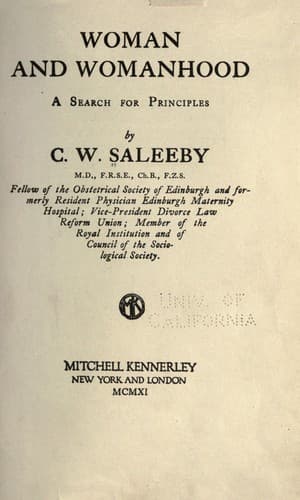
Woman and Womanhood: A Search for PrinciplesSaleeby, C. W. (Caleb Williams)
Science
Woman and Womanhood: A Search for Principles
Saleeby, C. W. (Caleb Williams)
Eugenics; Women
and the laws of life in their analyses. An institution like marriage is
criticized by those who think that it is an ecclesiastical invention of
yesterday, and that what hands have made, hands can destroy, though
marriage is aeons older even than the mammalian order. They take
transient, artificial conditions, lasting not for a second in the
history of mankind seen as a whole, and simply accepting these
conditions as part of the order of nature, they ask us to overthrow an
institution which is immeasurable ages older than man himself. The odds
are somewhat against them, one may surmise, but they may do considerable
injury to their own age notwithstanding.
After having dealt with this fundamental biological condition of
marriage, we must next turn to a psychological question which is
scarcely less important. The human being is immensely complex both in
composition and in needs, and the institution of monogamy does not
become easier of maintenance as human complexity increases. Amongst the
lower animals or even amongst the lower races of mankind, the relations
between the sexes are mostly confined to one sphere, but amongst
ourselves the problem is to mate for life complex individuals whose
needs are many, ranging from the purely physical to the purely
psychical. Thus it is a matter of common experience that whilst one
woman meets one part of a man's needs, another meets another, and this
of course with grave prejudice to monogamy. Some of the modern writers
to whom allusion has been made suggest that these different needs want
sorting out; that one woman is to be the intellectual companion of a
man, and another the mother of his children. But though men and women
are multiple and complex, they are in the last resort unities. These
absolute distinctions between one need and another do not work out in
practice. Anything which tends toward splitting up the human personality
must be a disservice to it. Nor do we desire that women of the higher
type, best fitted to be the intellectual companions of men, shall be
those who do not contribute to the future of the race. From the eugenic
point of view the mother is every whit as important as the father. I do
not believe for a moment that these more or less definite proposals of
Mr. Shaw and Mr. Wells are soundly based, and perhaps indeed it is not
necessary to argue against them at greater length. Of more value is it
to ask ourselves whether feminine nature may not prove itself quite
equal to the task of meeting all the needs of masculine nature.
It seems to me that the right answer, in many cases at any rate, to the
wife's question, how is she to retain the whole of her husband's
interest, is hinted at in Mr. Somerset Maugham's recent play
"Penelope"--she must be many women to him herself. And this the wise and
happy woman is, though I do not think the phrase "many women" at all
covers the variety of feeling to which the ideal woman can appeal.
Public-domain text, read in full here on John Shaqi.
Reviews
Reviews
No reviews yet
Be the first to share your thoughts on this work.
Elsewhere in the archive
Join the Discussion
Join the discussion
Sign in to leave a comment or review.
Sign InorCreate an account