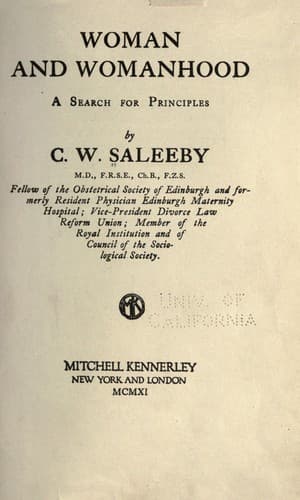
Woman and Womanhood: A Search for PrinciplesSaleeby, C. W. (Caleb Williams)
Science
Woman and Womanhood: A Search for Principles
Saleeby, C. W. (Caleb Williams)
Eugenics; Women
We then discussed and criticized a second argument for polygamy, based
upon the assumption that a man requires more from women than one woman
can afford him. The answer to that argument is that many women exist who
meet all their husbands' needs and satisfy all their instincts, and that
for this end the intensive education of woman's intellect is not a
necessary condition. It may be added that if the race is to rise, the
highest type of women as well as the highest type of men must be its
parents, the mothers being exactly as important as the fathers on the
score of heredity. Any attempt, therefore, to split up womanhood, so
that the lower types shall become the mothers, and the higher the
companions of men, is a directly dysgenic proposal, opposing the great
eugenic principle that the best of both sexes must be the parents of the
future.
When we find, therefore, that marriage under present conditions does
not satisfy many of the highest kinds of women, we must ask whether
their dissatisfaction is warranted, and if, as we do, we find it based
upon the fact that the present conditions are grossly unjust to women,
we must modify those conditions so that, at the very least, the wife and
mother shall not have the worst of them.
Finally, whatever we may fail to achieve because, for instance, of some
fundamental facts of human nature against which it is vain to legislate,
at least we have economic conditions under our control, and control them
we must, so that, whoever shall be in a position of economic insecurity,
at least it shall not be the mothers of the future. Our first concern
must be to safeguard them, whosoever else is inconvenienced. In deciding
how this is effected we are to be guided by that great fact of
increasing paternal responsibility which is demonstrated by the history
of animal evolution since the appearance of the earliest vertebrates,
and of which marriage, in all its forms, is at bottom the human and
social expression. We are to recognize that if sub-human fathers are in
any degree held by nature responsible with their mates for the care of
their offspring, much more should this be true of man, "made with such
large discourse, looking before and after," who is to be held
responsible for all his acts, and most of all for those most charged
with consequence. The man who brings children into the world is
responsible to their mother and through her to society at large, which
must see to it that that responsibility is not evaded. At present in
England the working man spends on the average not less than one-sixth
of his entire income on alcoholic drinks, whilst society yearly pays for
the feeding of more of his children. But it is not good enough that the
father shall swallow the interests of the future in this fashion. As the
State in Germany takes a percentage of his earnings in order to protect
him against the risks of the future, so we must see to it that the
Public-domain text, read in full here on John Shaqi.
Reviews
Reviews
No reviews yet
Be the first to share your thoughts on this work.
Elsewhere in the archive
Join the Discussion
Join the discussion
Sign in to leave a comment or review.
Sign InorCreate an account