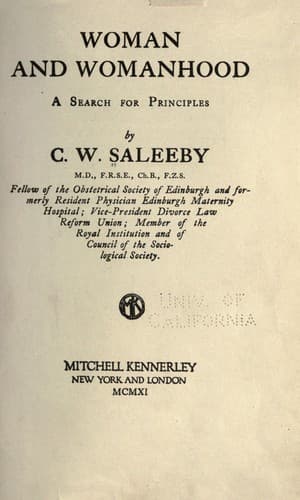
Woman and Womanhood: A Search for PrinciplesSaleeby, C. W. (Caleb Williams)
Science
Woman and Womanhood: A Search for Principles
Saleeby, C. W. (Caleb Williams)
Eugenics; Women
Our right attitude toward married women's labour must depend upon a
right understanding of the social meaning of marriage. This was a
question which had to be dealt with at length in a previous volume and I
can only state here in a word, what was the conclusion come to. It was
that marriage is a device for supporting and buttressing motherhood by
fatherhood. Its mark is that it provides for _common parental care of
offspring_. A more prosaic way of stating the case would be that
marriage is a device for making the father responsible. If we go far
back in the history of the animal world, we find mating but not
marriage. The father's function is purely physiological, transient and
wholly irresponsible. The whole burden of caring for offspring, when
first there comes to be need for that care, in the history of organic
progress, falls upon the mother. But even amongst the fishes we find
that sometimes, as in the case of the stickleback, the father helps the
mother to build a sort of nest, and does "sentry-go" outside it to keep
off marauders. In this common care of the young we see what is in all
essentials marriage, though some may prefer to dignify the word by
confining it to those human associations which have been blessed by
Church and State, even though the father throws the baby at the mother,
or sends her into the streets to earn her bread and his beer.
If some of our modern reformers knew any biology, or even happened to
visit a music-hall where the biograph was showing scenes of bird-life,
they would learn that the human arrangement whereby the father goes out
and forages for mother and children has roots in hoary antiquity. The
pity is that there is no one to point the moral to the crowd when the
father-bird is seen returning with delicacies for the mother, who tends
her nest and its occupants.
The reader will already have anticipated the conclusion, to which, as I
see it, the study of the fundamental laws of life must lead the
sociologist in this case. It is that the duty of the father is to
support the mother and children, and that the duty of the State is to
see that he does this.
Thus, if asked whether I believe in the endowment of motherhood, I
reply, yes, indeed, I believe in the endowment of motherhood by the
corresponding fatherhood. If our first principles are sound, we must
believe that the mother must be endowed or provided for; there can be no
difference of opinion so far. Often, as we have seen, there is no
corresponding fatherhood, for the mother may be a widow, or unmarried
and unable to find the father. But where the corresponding fatherhood
exists, we fly directly in the face of Nature, we deny the consistent
teaching of evolution as the study of sub-human life reveals it to us,
if we do not turn to the father and say, this is your act, for which you
are responsible.
Public-domain text, read in full here on John Shaqi.
Reviews
Reviews
No reviews yet
Be the first to share your thoughts on this work.
Elsewhere in the archive
Join the Discussion
Join the discussion
Sign in to leave a comment or review.
Sign InorCreate an account