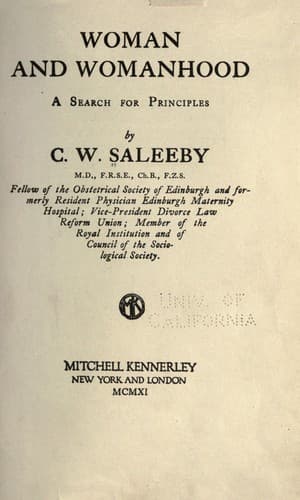
Woman and Womanhood: A Search for PrinciplesSaleeby, C. W. (Caleb Williams)
Science
Woman and Womanhood: A Search for Principles
Saleeby, C. W. (Caleb Williams)
Eugenics; Women
Fatherhood of the new order will not be so wholly irksome and unrewarded
as might at first appear to the critic who does not reckon children as
rewards themselves. It may involve some momentary sacrifices, but it
needs very little critical study of the ordinary man's expenditure to
discover that, on the whole, these sacrifices will be more apparent than
real. It is, for instance, a very great sacrifice indeed for the smoker
to give up tobacco; but once he has done so, he is as happy as he was,
and suffers nothing at all for the gain of his pocket. Both as regards
alcohol and tobacco, the common expenditure which would so amply provide
milk and the rest for children, is necessitated by an acquired habit
which, like all acquired habits, can be discarded. The non-smoker and
non-drinker does _not_ suffer the discomfort of the smoker and drinker
who is deprived of his need. These things cease to be needs at all, soon
after they are dispensed with, or if the habit of taking them is never
begun. They are luxuries only to those who use them. To those who do not
they are nothing, and the lack of them is nothing. The sheer waste they
entail is gigantic, and the expenditure on them in such a country as
England would endow all its motherhood and provide good conditions for
all its children. The father who, in the future, is compelled to yield
the rights of mothers and children, may sometimes be compelled to
practise what at first looks like great self-restraint in these
respects. The point I wish to make is that the sacrifice and the need
for restraint are transient, and that thereafter there is simply more
liberty and the promise of longer life for the wise.
The working-out will be that the legislation of the future will benefit
the right kind of husband and father, but will restrain and irk the
wrong kind. But that is precisely what good legislation should do. Thus
the right kind of father, who in any case will do his best to care for
his wife and children, will be helped in the future by the State. It
will insist that he does the duty which in any case he means to do, but
it will make the doing easier. We see admirably working parallels to
this in the German insurance laws and their provision for death, disease
and old age. They benefit those whom they appear to harass. Insurance
against fatherhood will work in the same way. The State will not be
antagonistic to the father, but will be his best friend, knowing that
_its_ best friends are good fathers and mothers. There will be far less
worry and anxiety for well-meaning parents, especially for mothers, but
also for fathers. Nor do I, for one, much mind how substantial may be
the State's contribution to the father's efforts, provided only that
those efforts are demanded and obtained.
Public-domain text, read in full here on John Shaqi.
Reviews
Reviews
No reviews yet
Be the first to share your thoughts on this work.
Elsewhere in the archive
Join the Discussion
Join the discussion
Sign in to leave a comment or review.
Sign InorCreate an account