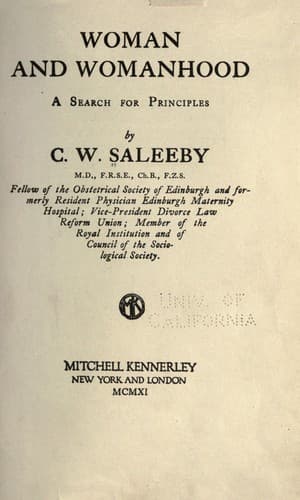
Woman and Womanhood: A Search for PrinciplesSaleeby, C. W. (Caleb Williams)
Science
Woman and Womanhood: A Search for Principles
Saleeby, C. W. (Caleb Williams)
Eugenics; Women
"It must then be concluded that parental and especially maternal
alcoholism of the kind to which the name of chronic drunkenness or
persistent soaking is applied, is the source of both ante-natal and
post-natal mortality. It acts in all the three ways in which I
indicated that ante-natal causes can be shown to act in relation to
the increase of infantile mortality, viz.,.by causing abortions.,
by predisposing to premature labours, and by weakening the infant
by disease or deformity so that it more readily succumbs to
ordinary morbid influences at and after birth. By causing diseases
of the kidneys and of the placenta it also leads to that failure of
the filter to which I have already referred; the placenta being
damaged, not only does the alcohol more readily pass through it
itself, but it is also possible for other poisons, germs, and
toxins to cross over into the fatal economy. So it comes about that
the most disastrous consequences are entailed upon the unborn
infant in connection with syphilis, lead-poisoning, fevers, and
the like in the intemperate mother."
The foregoing was written as long ago as 1906, and various workers have
helped to confirm it since that date.
We must further learn that alcohol taken by the mother who nurses her
child has an organic relation to the child after birth. It is true,
indeed, that according to a celebrated observer, Professor von Bunge,
the influence of alcoholism in preceding generations is such that the
daughters of such a stock are mostly unable to nurse their children. It
is not quite certain that Professor von Bunge has proved his case, but
it is definitely proved that even if alcoholism in the maternal
grandparent has not altogether prevented a child from being fed in the
natural fashion, it may yet suffer gravely in consequence of receiving
alcohol in its mother's milk. In the case of the nursing mother, there
is one fresh avenue of excretion which the organism can employ for
ridding itself of the poison, and to the efforts of the lungs and the
kidneys are added those of the breasts. Alcohol can be readily traced in
the mother's milk within twenty minutes of its entry into her stomach,
and may be detected in it for as long as eight hours after a large dose.
Many cases are on record where infants at the breast have thus become
the subjects of both acute and chronic alcoholic poisoning. We have
numerous reports of convulsions and other disorders occurring in infants
when the nurse has taken liquor, and ceasing when she has been put on a
non-alcoholic diet. A most distinguished lady, Dr. Mary Scharlieb, may
be quoted in this connection, or the reader may indeed refer to the
chapter, "Alcoholism in Relation to Women and Children," contributed by
her to the volume "The Drink Problem" in my New Library of Medicine. She
says, "The child, then, absolutely receives alcohol as part of his diet
Public-domain text, read in full here on John Shaqi.
Reviews
Reviews
No reviews yet
Be the first to share your thoughts on this work.
Elsewhere in the archive
Join the Discussion
Join the discussion
Sign in to leave a comment or review.
Sign InorCreate an account