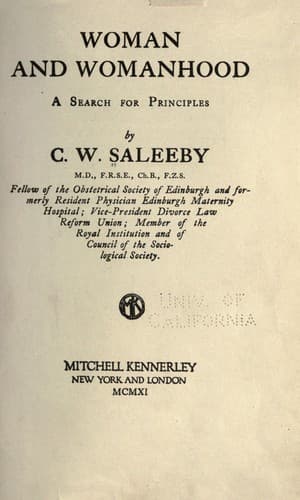
Woman and Womanhood: A Search for PrinciplesSaleeby, C. W. (Caleb Williams)
Science
Woman and Womanhood: A Search for Principles
Saleeby, C. W. (Caleb Williams)
Eugenics; Women
If the sound of hope is not heard as the ground-tone of these chapters,
let it ring through all else at the end. I am an optimist because I am
an evolutionist, and because I believe, as every one of those whom I
call Eugenists must, that the best is yet to be. The dawn is breaking
for womanhood, and therefore for all mankind. If we are asked to express
in one phrase the reason why this hope is justified, it is because the
long struggle between two antithetic conceptions of human society is
reaching a definite issue.
These radically opposed ideas may for convenience be called the
_organic_ and the _internecine_. The internecine conception of society
forever sets nation against nation, race against race, class against
class, sex against sex, individual against individual, on the ground
that the interest of one must be the injury of the other. It is false.
Nay, more, for man living his life on this earth as he must and will, it
is the Great Lie.
And it is being found out. Even international trade and commerce, from
which such a service could scarcely have been expected, are here
contributing to philosophy. Our fathers talked of the comity of nations;
we are beginning to discover their interdependence. The coming of that
discovery is one of the few really new things under the sun. Not so very
long ago, when mankind was far less numerous, such interdependence of
nations did not exist; they were self-sufficient, just as the
patriarchal family was self-sufficient still further ago.
But the interdependence of the sexes is so far from being a new fact
that it is as old as the evolution of sex, and the decadence and
disappearance of parthenogenesis or reproduction from the female sex
alone. Once bi-parental reproduction becomes necessary for the
continuance of the race, both sexes sink with either, and neither can
swim but with both. Yet so far are we from realizing this most ancient
of facts to-day that, on both sides of the woman question, wonderful to
relate, are to be found controversialists who are seeking to deny this
continuous lesson of so many million ages. The reader may take his
choice of folly between them. On the one hand, there are the feminists
who seek to do without man,--except for the minimum physiological
purpose. The women are to sustain the present and create the future
simultaneously, and man is to be reduced, apparently, to the function of
the drone. Thus Mrs. Gilman in "Women and Economics." Over against her
and those who think with her are to be set the men, and women too, who
tell us that "men made the State,"--a sufficiently shameful
admission--and that women have no business with these things. Do not
their mothers blush for such; to have travailed so much, and to have
achieved so little?
Public-domain text, read in full here on John Shaqi.
Reviews
Reviews
No reviews yet
Be the first to share your thoughts on this work.
Elsewhere in the archive
Join the Discussion
Join the discussion
Sign in to leave a comment or review.
Sign InorCreate an account