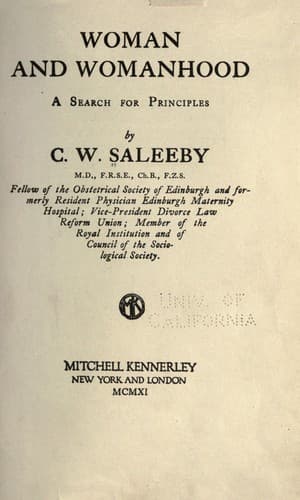
Woman and Womanhood: A Search for PrinciplesSaleeby, C. W. (Caleb Williams)
Science
Woman and Womanhood: A Search for Principles
Saleeby, C. W. (Caleb Williams)
Eugenics; Women
[10] The modern use of the word environment really dates from Lamarck's
original phrase. In his discussion of the characters of living beings,
he spoke of the _milieu environnant_. The higher the type of organism
the more comprehensive must the term become, not only quantitatively but
qualitatively.
[11] "An Introduction to Social Psychology," by William McDougall, M.A.,
M.B., M.Sc., Wilde Reader in Mental Philosophy in the University of
Oxford.
[12] From the writer's paper, "The Human Mother," in the Report of the
Proceedings of the National Conference on Infantile Mortality, 1908, p.
30.
[13] It it well to quote here the most recent comment of the late Sir
Francis Galton upon this subject. It is to be found in his celebrated
Huxley lecture, now published by the Eugenics Education Society,
together with much of the illustrious author's other work, under the
title, "Essays in Eugenics." The passage relevant to our discussion runs
as follows:--
"There appears to be a considerable difference between the earliest age
at which it is physiologically desirable that a woman should marry and
that at which the ablest, or at least the most cultured, women usually
do. Acceleration in the time of marriage, often amounting to seven
years, as from twenty-eight or twenty-nine to twenty-one or twenty-two,
under influences such as those mentioned above, is by no means
improbable. What would be its effect on productivity? It might be
expected to act in two ways:--
"(1) By shortening each generation by an amount equally proportionate to
the diminution in age at which marriage occurs. Suppose the span of each
generation to be shortened by one-sixth, so that six take the place of
five, and that the productivity of each marriage is unaltered, it
follows that one-sixth more children will be brought into the world
during the same time, which is roughly equivalent to increasing the
productivity of an unshortened generation by that amount.
"(2) By saving from certain barrenness the earlier part of the
child-bearing period of the woman. Authorities differ so much as to the
direct gain of fertility due to early marriage that it is dangerous to
express an opinion. The large and thriving families that I have known
were the offspring of mothers who married very young."
[14] An unavoidable delay in the publication of this book makes possible
reference to Professor Ehrlich's synthetic compound of arsenic, known as
"606," the anti-syphilitic potency of which will render even less
excusable the cowardice and neglect against which the foregoing is a
protest.
[15] This is a libel upon poor people everywhere. There has been some
confusion between drink and poverty.
[16] "T. P.'s Weekly," Christmas Number, 1909.
Public-domain text, read in full here on John Shaqi.
Reviews
Reviews
No reviews yet
Be the first to share your thoughts on this work.
Elsewhere in the archive
Join the Discussion
Join the discussion
Sign in to leave a comment or review.
Sign InorCreate an account