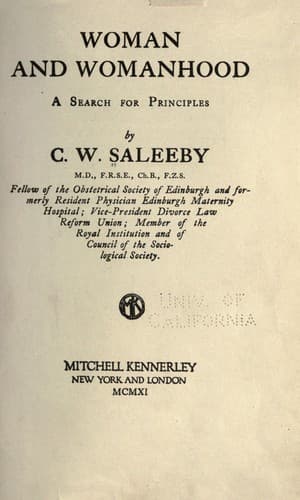
Woman and Womanhood: A Search for PrinciplesSaleeby, C. W. (Caleb Williams)
Science
Woman and Womanhood: A Search for Principles
Saleeby, C. W. (Caleb Williams)
Eugenics; Women
Despite the abundance of the material and the opportunities for
observation, we are at present without decisive evidence as to the
distinctiveness of sex in any effective way during childhood. Here, as
elsewhere, we have to guard ourselves against the influences of nurture
in the widest sense of the word; as when, to take an extreme case, we
distinguish between the boy and the girl because the hair of the one is
cut and of the other is not. The natural, as distinguished from the
nurtural, distinctions at this period are probably much fewer than is
supposed. It is asserted--to take physical characters first--that the
girl of ten gives out in breathing considerably less carbonic acid than
her brother of the same age, thus foreshadowing the difference between
the sexes which is recognized in later years. If this fact be critically
established it is of very great interest, showing that the sex
distinction effectively makes its presence felt in the most essential
processes of the body. But we should require to be satisfied that the
observations were sufficiently numerous, and were made under absolutely
equal conditions, and with due allowance for difference in body-weight.
They would be the more credible if it were also shown that the number of
the red blood corpuscles were smaller in girls than in boys in parallel
with the difference between the sexes in later years.
Children of both sexes have fewer red blood corpuscles in a given
quantity of blood and a smaller proportion of the red colouring matter,
or haemoglobin, than adults. Women have very definitely fewer red blood
corpuscles than men, and a smaller proportion of haemoglobin, and their
blood is more watery. According to one authority this difference in the
haemoglobin can be observed from the ages of eleven to fifty, but not
before. The specific gravity of the blood is found to be the same in
both sexes before the fifteenth year. Thereafter, that of the boy's
blood rises, and between seventeen and forty-five is definitely higher
than in women of the corresponding age. It thus seems quite clear that,
as we should expect, these differences in the blood, which are
certainly, as Dr. Havelock Ellis says, fundamental, make their
appearance definitely at puberty--a fact which supports the view that
fundamental differences of practical importance between the two sexes
before that age are not to be found. Careful comparative study of the
pulse of children is hitherto somewhat inconclusive, though it is well
known that the pulse is more rapid in women than in men.
Public-domain text, read in full here on John Shaqi.
Reviews
Reviews
No reviews yet
Be the first to share your thoughts on this work.
Elsewhere in the archive
Join the Discussion
Join the discussion
Sign in to leave a comment or review.
Sign InorCreate an account