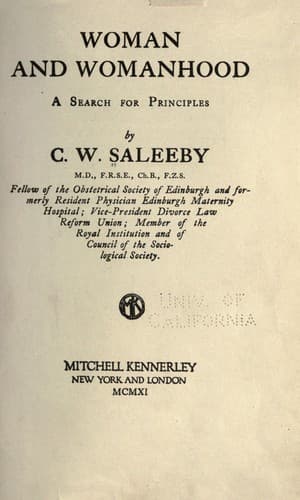
Woman and Womanhood: A Search for PrinciplesSaleeby, C. W. (Caleb Williams)
Science
Woman and Womanhood: A Search for Principles
Saleeby, C. W. (Caleb Williams)
Eugenics; Women
On the other hand, it seems clear as regards respiration that as early
as the age of twelve there are definite differences between the sexes.
Several thousands of American school children were examined, and between
the ages of six and nineteen the boys were throughout superior in lung
capacity. The girls had almost reached their maximum capacity at the age
of twelve, and thereafter the difference, till then slight, rapidly
increased.[6] It appears that from eight to fifteen years of age a boy
burns more carbon than a girl, the difference, however, being not great.
But at puberty the boy proceeds to consume very nearly twice as much
carbon per hour as his sister.
Perhaps the matter need not be pursued further. It is sufficient for us
to recognize that puberty is really the critical time, and that in the
consideration of womanhood we may, on the whole, be justified in looking
upon the problem of the girl before that age as almost identical with
her brother's. Yet we must be reasonably cautious, since our knowledge
is small, and there is some by no means negligible evidence of
fundamental physiological differences between the sexes before puberty,
relatively slight though these may be. Therefore, though on the whole
we need make few distinctions between the girl and her brother, and
though we are doubtless wrong in the magnitude of the practical
distinctions which we have often made hitherto, yet we must remember
that these are going to be different beings, and that the main
principles which determine our nurture of womanhood may be recalled when
we are doubtful as to practice in the care of the girl child.
Physiological distinctions, we have seen, probably exist during these
early years, but are of less importance than we sometimes have attached
to them, and of no importance at all compared with what is to come.
Psychological distinctions, we may believe, are still more dubious. For
instance, it is generally believed that the parental instinct shows
itself much more markedly in girls than in boys, and the commonly
observed history of the liking for dolls is quoted in this connection.
As this instinct bears so profoundly upon the later life of the
individual, and as we may reasonably suppose the child to be the mother
of the woman as well as the father of the man, the matter is worth
looking at a little further.
But, in the first place, it has been asserted that the doll instinct has
really nothing whatever to do with the parental instinct in either sex.
Psychologists, whom one suspects of being bachelors, tell us that what
we really observe here is the instinct of acquisition: it really does
not matter what we give the child, though it so happens that we very
commonly present it with dolls; it is the lust of possession that we
satisfy, and in point of fact one thing will satisfy it as well as
another.
Public-domain text, read in full here on John Shaqi.
Reviews
Reviews
No reviews yet
Be the first to share your thoughts on this work.
Elsewhere in the archive
Join the Discussion
Join the discussion
Sign in to leave a comment or review.
Sign InorCreate an account