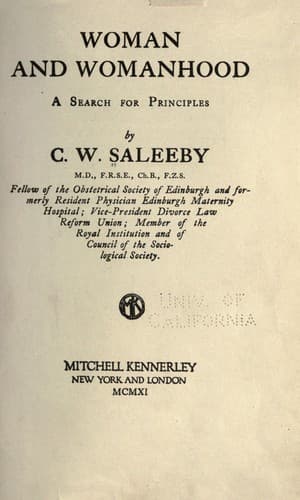
Woman and Womanhood: A Search for PrinciplesSaleeby, C. W. (Caleb Williams)
Science
Woman and Womanhood: A Search for Principles
Saleeby, C. W. (Caleb Williams)
Eugenics; Women
Now it will be granted, in the first place, that by physical
training--whether in the form of gymnastics or games or what not--we
desire to produce a healthier and more perfectly developed body. Some
will add a stronger body, but as this term has two meanings constantly
confused, it really contains the crux of the question. Stronger may mean
stronger in the sense of resistance to disease or fatigue or strain of
any kind, or it may mean stronger in the sense of the capacity to
perform feats of strength. It being commonly assumed that vitality and
muscularity are identical, this distinction is, on that assumption,
merely academic and trivial. But as muscularity and vitality are not
identical, and have indeed very little to do with each other, and as
muscularity may even in certain conditions prejudice vitality, the
distinction is not academic but all-important. I freely assert that it
is substantially ignored by those who concern themselves with physical
training, whether of boys or girls or recruits, all the world over.
Though a woman is naturally less muscular than a man, her vitality is
higher. This seems to be a general truth of all female organisms. The
evidence is of many orders. Thus, to begin with, women live longer, on
the average, than men do. In the light of our modern knowledge of
alcohol, however, we cannot regard this fact by itself as conclusive,
since the average age attained by men is undoubtedly considerably
lowered by alcohol, and of course to a much greater extent than obtains
in the case of women. But women recover better from poisoning, such as
occurs in infectious disease, and they are far more tolerant of loss of
blood, as indeed they have to be. The same applies to loss of sleep or
food, and to injurious influences generally. These indisputable proofs
of superior vitality co-exist with much inferior muscularity, and are
conclusive on the point. If men would make observations among themselves
and think for a moment, they would soon perceive how foolish they are in
crediting the assumptions of the strong men who so successfully persuade
the public that the great thing is for a man to have big muscles. Men,
muscular by nature, and still more so by nurture, are often in point of
fact really weak compared with much less muscular men who, though they
cannot put forth so much mechanical energy at a given moment, can yet
endure fifty times the fatigue or stress or poisoning of any order.
From the point of view of any sound physiology there is no comparison at
all between the absurd strong man and the slight Marathon runner of
small muscles but splendid vitality. If we are to test vitality in
muscular terms at all--that in itself being a quite indefensible
assumption--we must do so in terms of endurance, and not in terms of
horse power or ass power, at any given moment.
Public-domain text, read in full here on John Shaqi.
Reviews
Reviews
No reviews yet
Be the first to share your thoughts on this work.
Elsewhere in the archive
Join the Discussion
Join the discussion
Sign in to leave a comment or review.
Sign InorCreate an account