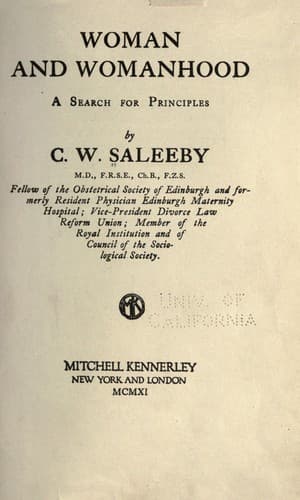
Woman and Womanhood: A Search for PrinciplesSaleeby, C. W. (Caleb Williams)
Science
Woman and Womanhood: A Search for Principles
Saleeby, C. W. (Caleb Williams)
Eugenics; Women
Further, this higher education of women--and we may be content to accept
the adjective without qualification, since it is after all only a
comparative, and leaves us free to employ the superlative--may be and
often is of very real value in certain cases and because of certain
local conditions, such as the great numerical inequality of the sexes in
nearly all civilized countries. It is valuable for that proportion of
women, whatever it be, who, through some throw of the physiological
dice, seem to be without the distinctive factor for psychical
womanhood, the existence of which one has tentatively ventured to
assume. These individuals, like all others, are entitled to the fullest
and freest development of their lives, and it is well that there shall
be open to them, as to the brothers they so closely resemble,
opportunities for intellectual satisfaction and self-development.
Therefore, surely, by far the most satisfactory function of higher
education for women is that which it discharges in reference to these
women. Their destiny being determined by their nature, and irrevocable
by nurture, it is well that, though we cannot regard it as the highest,
we should make the utmost of it by means of the appropriate education.
Only because sometimes we must put up with second bests can we approve
of higher education for women other than those of the anomalous
semi-feminine type to which we have referred. At present we must accept
it as an unfortunate necessity imposed upon us by economic conditions.
So long as society is based economically, or rather uneconomically, upon
the disastrous principles which so constantly mean the sacrifice of the
future to the present, so long, I suppose, will it be impossible that
every fully feminine woman shall find a livelihood without some
sacrifice of her womanhood. This is a subject to which we must return in
a later chapter. Meanwhile it is referred to only because its
consideration shows us some sort of excuse, if not warrant, for the
higher education of woman, even though in the process of thus endowing
her with economic independence, we disendow her of her distinctive
womanhood, or at the very least imperil it; even though, more serious
still, we deprive the race of her services as physical and psychical
mother.
Public-domain text, read in full here on John Shaqi.
Reviews
Reviews
No reviews yet
Be the first to share your thoughts on this work.
Elsewhere in the archive
Join the Discussion
Join the discussion
Sign in to leave a comment or review.
Sign InorCreate an account