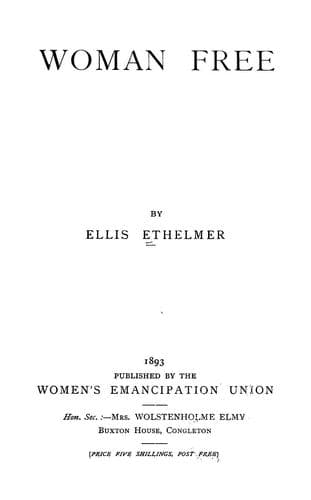
English poetry -- 19th century; Women -- History; Women -- Social conditions; Women -- Suffrage
“Manner,” or “custom” is the early Biblical definition for this habit
(_vide_ Gen. xviii. 11, and xxxi. 35). It may be noticed that the word
is not rendered or translated as “nature.” It is also called “sickness”
(Lev. xx. 18); and “pollution” (Ezek. xxii. 10). See also Note XXV. 8.
The authorised version of the Bible is here referred to. The euphemisms
attempted in the recent revised version as amendments of some of these
passages are equally consonant with the argument of this note.
XXV.
1.—“_Vicarious punishment_ ...”
Revolting was the shock to the writer, coming, some years ago, with
unprejudiced and ingenuous mind, to the study of the so-called “Diseases
of Women,” on finding that nearly the whole of these special “diseases,”
including menstruation, were due, directly or collaterally, to one form
or other of _masculine_ excess or abuse. Here is a nearly coincident
opinion, afterwards met with:—“The diseases peculiar to women are so
many, of so frequent occurrence, and of such severity, that half the
time of the medical profession is devoted to their care, and more than
half its revenues depend upon them. We have libraries of books upon
them, special professorships in our medical colleges, and hosts of
doctors who give them their exclusive attention.... The books and
professors are all at fault. They have no knowledge of the causes or
nature of these diseases” (or at least they do not publish it, or act on
it), “and no idea of their proper treatment. Women are everywhere
outraged and abused. When the full chapter of woman’s wrongs and
sufferings is written, the world will be horrified at the hideous
spectacle....”—T. L. Nichols, M.D. (“Esoteric Anthropology,” p. 198).
So, again, in speaking of menorrhagia:—“The causes of this disease,
whatever they are, must be removed. Thousands of women are consigned to
premature graves; some by the morbid excesses of their own passions, but
far more by the sensual and selfish indulgences of those who claim the
legal right to murder them in this manner, whom no law of homicide can
reach, and upon whose victims no coroner holds an inquest.”—(_Op. cit._,
p. 301.)
2.—“... _grievous toll_ ...”
And this in every grade of society, even to the pecuniary loss, as well
as discomfort, of the labouring classes of women.
“Statistics of sickness in the Post Office show that women” (these are
unmarried women) “are away from their work more days than men.”—(Sidney
Webb, at British Association, 1891.)
5.—“... _no honest claim_.”
Public-domain text, read in full here on John Shaqi.
Reviews
Reviews
No reviews yet
Be the first to share your thoughts on this work.
Join the Discussion
Join the discussion
Sign in to leave a comment or review.
Sign InorCreate an account