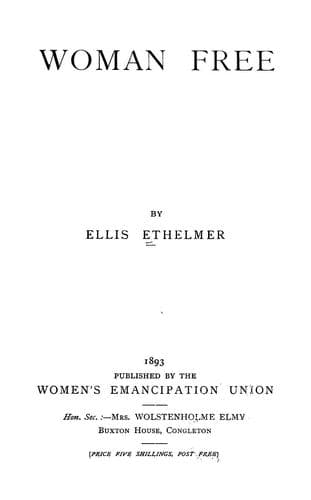
English poetry -- 19th century; Women -- History; Women -- Social conditions; Women -- Suffrage
The _Times_ of Aug. 3, 1892, reports a paper by Professor Lombroso, of
Turin (at the International Congress of Psychology, London), in which
occurs the following:—“It must be observed that woman was exposed to
more pains than man, because man imposed submission and often even
slavery upon her. As a girl, she had to undergo the tyranny of her
brothers, and the cruel preferences accorded by parents to their male
children. Woman was the slave of her husband, and still more of social
prejudices.... Let them not forget the physical disadvantage under which
she had to labour. She might justly call herself the pariah of the human
family.”
The word is apt and corroborative, for it was no honest act—it was not
Nature, but human cruelty and injustice that formed a pariah.
8.—“... _opprobrious theme_.”
_Conf._ ancient and mediæval superstitions and accusations on the
subject. Raciborski notes these aspersions (Traité, p. 13):—“Pline
prétendait que les femmes étant au moment des règles pouvaient dessécher
les arbres par de simples attouchements, faire périr des fruits, &c.,
&c.” And a further writer says more fully:—“Pliny informs us that the
presence of a menstrual woman turns wine sour, causes trees to shed
their fruit, parches up their young fruit, and makes them for ever
barren, dims the splendour of mirrors and the polish of ivory, turns the
edge of sharpened iron, converts brass into rust, and is the cause of
canine rabies. In Isaiah xxx. 22, the writer speaks of the defilement of
graven images, which shall be cast away as a menstruous cloth; and in
Ezekiel xviii. 6, and xxxvi. 17, allusions of the same import are made.”
Unless we accept the antiquated notion of a “special curse” on women,
how reconcile the idea of an “ordinance of Nature” being so repulsively
and opprobriously alluded to? Well may it be said:—“Ingratitude is a
hateful vice. Not only the defects, but even the illnesses which have
their source in the excessive” (man-caused) “susceptibility of woman,
are often made by men an endless subject of false accusations and
pitiless reproaches.”—(M. le Docteur Cerise, in his Introduction to
Roussel, p. 34.)
XXVI.
1.—“_Thoughts like to these are breathings of the truth_.”
“I submit that there is a spiritual, a poetic, and, for aught we know, a
spontaneous and uncaused element in the human mind, which ever and anon
suddenly, and without warning, gives us a glimpse and a forecast of the
future, and urges us to seize truth, as it were, by anticipation. In
attacking the fortress we may sometimes storm the citadel without
stopping to sap the outworks. That great discoveries have been made in
this way the history of our knowledge decisively proves.”—H. T. Buckle
(“Influence of Women on the Progress of Knowledge”).
Public-domain text, read in full here on John Shaqi.
Reviews
Reviews
No reviews yet
Be the first to share your thoughts on this work.
Join the Discussion
Join the discussion
Sign in to leave a comment or review.
Sign InorCreate an account