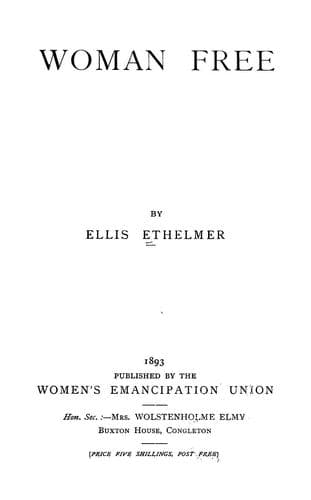
English poetry -- 19th century; Women -- History; Women -- Social conditions; Women -- Suffrage
“He (Mr. Frederic Harrison) says—‘All women, with few exceptions, are
subject to functional interruption absolutely incompatible with the
highest forms of continuous pressure.’ This assertion I venture most
emphatically to deny. The actual period of child-birth apart, the
ordinarily healthy woman is as fit for work every day of her life as the
ordinarily healthy man. Fresh air, exercise, suitable clothing and
nourishing food, added to the habitual temperance of women in eating and
drinking, have brought about a marvellously good result in improving
their average health.”—Mrs. Fawcett (_Fortnightly Review_, Nov. 1891).
(See also Note LX., 8.)
8.—“_The sage physician, she_ ...”
Not only “sage” physician, but “brave” physician; for brave indeed has
been the part she has had to bear against male professional prejudice
and jealousy, opposition from masculine vested interests, virulent abuse
and even personal violence. So recently as 1888, Dr. Sophia Jex-Blake
has to report concerning the medical education of women, that:—
“The first difficulty lies in some remaining jealousy and ill-will
towards medical women on the part of a section (constantly
diminishing, as I believe) of the medical profession itself. Some
twenty years ago the professional prejudice was so deep and so widely
spread that it constituted a very formidable obstacle, but it has been
steadily melting away before the logic of facts; and now is, with a
few exceptions, rarely to be found among the leaders of the
profession, nor indeed among the great majority of the rank and file,
as far as can be judged by the personal experience of medical women
themselves. Unfortunately, it seems strongest just where it has least
justification, viz., among the practitioners who devote themselves
chiefly to midwifery, and to the special diseases of women. The
Obstetrical Society is, so far as I know, still of the same mind as
when, in 1874, they excluded Dr. Elizabeth Garrett Anderson, a
distinguished M.D. of Paris, from their membership; and the Soho
Square Hospital for Women has never revoked its curt refusal to allow
me to enter its doors, when, in 1878, I proposed to take advantage of
the invitation issued in its report to all practitioners who were
specially interested in the cases for which the hospital is reserved.
Sometimes this jealousy takes a sufficiently comic form. For instance,
I received for two successive years a lithographed circular inviting
me by name to send to the _Lancet_ the reports of interesting cases
that might occur in my dispensary practice, but when I wrote in
response to this supposed offer of professional fellowship, I received
by next post a hurried assurance from the editor that it was all a
mistake, and that, in fact, the _Lancet_ could not stoop to record
medical experiences, however interesting, if they occurred in the
practice of the inferior sex! Probably it will not require many more
Public-domain text, read in full here on John Shaqi.
Reviews
Reviews
No reviews yet
Be the first to share your thoughts on this work.
Elsewhere in the archive
Join the Discussion
Join the discussion
Sign in to leave a comment or review.
Sign InorCreate an account