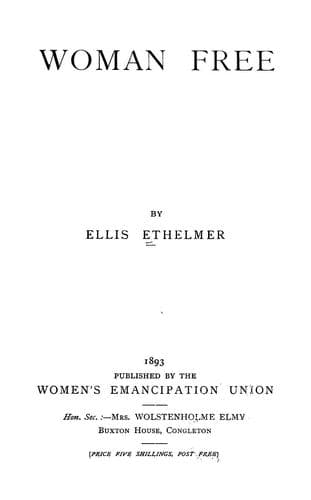
English poetry -- 19th century; Women -- History; Women -- Social conditions; Women -- Suffrage
years to make this sort of thing ridiculous, even in the eyes of those
who are now capable of such puerilities.
“The second obstacle lies in the continued exclusion of women from the
majority of our Universities, and from the English Colleges of
Physicians and Surgeons. Here also the matter may be left to the
growth of public opinion as regards those existing bodies which do not
depend upon the public purse; but it is time that Parliament should
refuse supplies to those bodies whose sense of justice cannot be
otherwise awakened, and it is certainly the duty of Government to see
that no new charter is granted without absolute security for equal
justice to students of both sexes.”—Sophia Jex-Blake, M.D.
(_Nineteenth Century_, Nov., 1887).
See also Note LVII., 1, and LVIII, 1.
_Id._... Progress is indeed being made, surely, yet slowly, for Mrs.
Fawcett has still necessity to reiterate, four years afterwards:—
“Make her a doctor, put her through the mental discipline and the
physical toil of the profession; charge her, as doctors are so often
charged, with the health of mind and body of scores of patients, she
remains womanly to her finger tips, and a good doctor in proportion as
the truly womanly qualities in her are strongly developed. Poor women
are very quick to find this out as patients. Not only from the immediate
neighbourhood of the New Hospital for Women, where all the staff are
women doctors, but also from the far East of London do they come,
because ‘the ladies,’ as they call them, are ladies, and show their poor
patients womanly sympathy, gentleness, and patience, womanly insight and
thoughtfulness in little things, and consideration for their home
troubles and necessities. It is not too much to say that a woman can
never hope to be a good doctor unless she is truly and really a womanly
woman. And much the same thing may be said with regard to fields of
activity not yet open to women.”—Mrs. Fawcett (_Fortnightly Review_,
Nov., 1891).
_Id._—“... _saviour of her sex_.”
Bebel says:—“Women doctors would be the greatest blessing to their own
sex. The fact that women must place themselves in the hands of men in
cases of illness or of the physical disturbances connected with their
sexual functions frequently prevents their seeking medical help in time.
This gives rise to numerous evils, not only for women, but also for men.
Every doctor complains of this reserve on the part of women, which
sometimes becomes almost criminal, and of their dislike to speak freely
of their ailments, even after they have made up their minds to consult a
doctor. This is perfectly natural, the only irrational thing about it is
the refusal of men, and especially of doctors, to recognise how
legitimate the study of medicine is for women.” (“Woman,” Walther’s
translation, p. 131.)
Public-domain text, read in full here on John Shaqi.
Reviews
Reviews
No reviews yet
Be the first to share your thoughts on this work.
Elsewhere in the archive
Join the Discussion
Join the discussion
Sign in to leave a comment or review.
Sign InorCreate an account