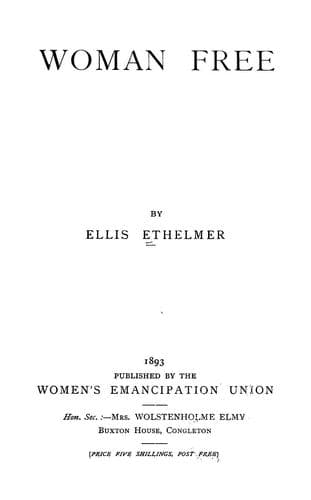
English poetry -- 19th century; Women -- History; Women -- Social conditions; Women -- Suffrage
_Id._... “As I am alluding to my own experience in this matter, I may
perhaps be allowed to say how often in the same place I have been struck
with the _contingent_ advantages attendant on the medical care by women
of women; how often I have seen cases connected with stories of shame or
sorrow to which a woman’s hand could far more fittingly minister, and
where sisterly help and counsel could give far more appropriate succour
than could be expected from the average young medical man, however good
his intentions. Perhaps we shall find the solution of some of our
saddest social problems, when educated and pure-minded women are brought
more constantly in contact with their sinning and suffering sisters, in
other relations as well as those of missionary effort.”—Dr. Sophia
Jex-Blake (Essay: “Medicine as a Profession for Women”).
XXX.
1.—“_With purer phase_ ...”
A noted specialist in this matter, Dr. Tilt, “basing his conclusions on
his own unpublished observations, and on those already made public by M.
Brierre de Boismont and Dr. Rawn,” has declared what is indeed a
generally accepted proposition, that “luxurious living and habits render
menstruation precarious, while this function is retarded by out-door
labour and less sophisticated habits.” (“Proceedings of British
Association,” 1850, p. 135; “On the Causes which Advance or Retard the
Appearance of First Menstruation in Women,” by E. J. Tilt, M.D., &c.,
&c.)
4.—“... _weakness_ ...”
It is to be carefully kept in mind that this “weakness” (Scriptural,
“sickness,” Lev. xx., 18) is strictly a pathological incident; while
maternity is truly a physiological one; the male false physicists seem
in their mental and clinical attitude to have aimed to precisely reverse
this definition. (See also Note XXIII., 8, and XXVI., 6.)
5, 6.—To the fact related in these two lines there is testimony in
nearly every book connected with the subject; and doubtless numerous
instances never come to light, owing to the very natural reticence
pointed out in Note XXIX., 8. The improved condition reported by Mrs.
Fawcett (Note XXIX., 6) is hence more readily verified by women
practitioners; and the writer has had detailed personal experiences of
perfect health and maternity being co-existent with little or no
appearance of the menses in the case of women whose names, if published,
would be indubitable guarantee for their accuracy and veracity.
7.—“_Not to neglectful man to greatly care_ ...”
Public-domain text, read in full here on John Shaqi.
Reviews
Reviews
No reviews yet
Be the first to share your thoughts on this work.
Elsewhere in the archive
Join the Discussion
Join the discussion
Sign in to leave a comment or review.
Sign InorCreate an account