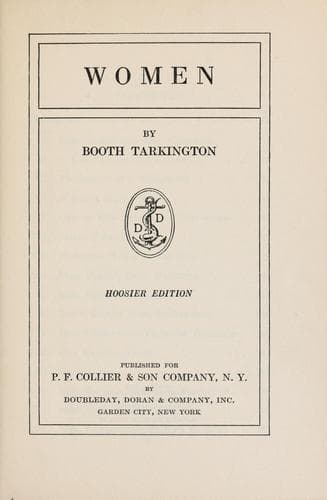
Married people -- Fiction; Suburban life -- Fiction; Women -- Fiction
He went away meekly to obey, and when he returned to the veranda he
still looked meek, though there was in his glance a sly skepticism
readily visible to his wife. She was sitting by the veranda railing with
her sister, who was staring forth into the darkness in a manner somewhat
pathetic; but, as her brother-in-law thought her imaginings absurd, his
sympathies were not greatly roused. “Hasn’t that old Don Giovanni of
yours finished playing it out yet, Mildred?” he inquired.
Both ladies looked round at him over their shoulders, Mildred piteously,
but Anne sternly. “There’s one great trouble with an unflagging humour,”
Mrs. Simms said. “It never flags.”
“Dear me!” he exclaimed. “If Mildred thinks poor old John and
Julietta—— Mildred, you don’t for one minute honestly and truly——”
But Mildred made a gesture of agonized entreaty. “Please! Please!” she
said in a low voice. “They’re coming!”
A peal of light laughter was heard from the darkness, and the figures of
the two delaying players became visible within the outer reaches of the
clubhouse lights. They were walking slowly, engaged in obviously
cheerful conversation, and from the shoulders of the stalwart Tower were
slung both bags containing the implements used in the game they had been
playing. It was characteristic and like old John’s punctilious
gallantry, his brother-in-law thought, to have seized upon both those
bags the moment the caddies were dismissed. Miss Voss, almost as tall as
he, was more than equal to carrying her own bag without effort.
She had the figure of a distance runner in training, lithe, hard, and
active; and there was something lively, yet hard, too, in her tanned
long face, which was a handsome face in spite of its length. But her
eyes were what was most noticeable about her, for they were beautiful.
They were brilliantly dark, and at times seemed to hold little dancing
lights within them, as if they gave glimpses of secret laughter. All in
all, she was a cheery companion for an outdoor afternoon, but by no
manner of means a tricky witch, Mr. Hobart Simms decided, as he looked
down smilingly upon her and upon that odd man, his brother-in-law and
junior partner, old John Tower.
“Old John,” of an age not more than Hobart’s, was queer, Hobart thought;
but his queerness did not alter the simple steadiness of character that
made his intimates think and speak of him as “old John.” Moreover, his
oddity lay mainly in his literal, simple truthfulness under all
conditions, in his belief that others were as truthful as himself, and
in an indefatigable formal politeness of manner, sometimes a little
stately, that was really the expression of a kind heart.
Public-domain text, read in full here on John Shaqi.
Reviews
Reviews
No reviews yet
Be the first to share your thoughts on this work.
Elsewhere in the archive
Join the Discussion
Join the discussion
Sign in to leave a comment or review.
Sign InorCreate an account