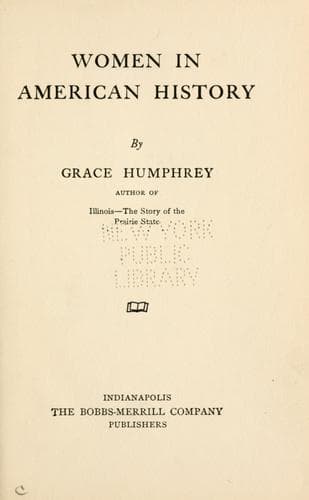
Women -- Biography; Women -- United States -- Biography
When she was sixteen her brother returned from several years of study
in Germany, and a new world was opened to her--German philosophy and
poetry, and simultaneously New York society; for at once he made the
Ward home one of the social centers of the city. Julia became the
reigning favorite and won everybody by her beauty and charm, her tact
and ready wit and good humor. She continued her studies regularly,
translating German and French and Italian poems, reading philosophy and
writing verses.
Visiting in Boston, she made the acquaintance of the literary group
there--Longfellow, Emerson, Whittier and Holmes. Charles Sumner was
her brother’s intimate friend, and one day when he and Longfellow
were calling on Miss Ward they suggested driving over to the Perkins
Institute for the Blind.
They had frequently talked to her of its founder, Doctor Samuel Gridley
Howe, the truest hero that America and their century had produced, and
withal the best of comrades. The Chevalier, they named him, a Bayard
without fear and without reproach. She knew something of the six years
he had spent in Greece, fighting during the war for independence
and serving as surgeon-in-chief. She knew of his pioneer work for
educating the blind, and of his marvelous achievement in teaching Laura
Bridgeman--the little blind and deaf and dumb girl, the statue which he
had brought to life.
When the three friends arrived Doctor Howe was absent, but before
they had finished their tour of the building Sumner spied him from
the window and called out, “There he is now, on his black horse.” The
young lady saw him, “a noble rider on a noble steed,” and into her
life he rode that day, like a medieval chevalier, in spite of the
fact that he was forty and she only twenty-four, in spite of the fact
that she had lived a gay social life and he was a serious reformer and
philanthropist who believed that with the world so full of needy people
no one had a right to luxury.
Life with a reformer husband was not always the care-free thing Julia
Ward had known, but she had shipped as mate for the voyage, she once
said with a merry laugh, and added, “I can not imagine a more useful
motto for married life.” She realized always that the deepest and
most steadfast part of herself she owed to Doctor Howe. “But for
the Chevalier, I should have been merely a woman of the world and a
literary dabbler.”
With all the cares and joys of a rich home life with her six children,
she found time for study and writing. She published two volumes of
verse, the first anonymously, but the secret could not be kept, for
people declared that no one but Julia Ward Howe could be its author.
Public-domain text, read in full here on John Shaqi.
Reviews
Reviews
No reviews yet
Be the first to share your thoughts on this work.
Elsewhere in the archive
Join the Discussion
Join the discussion
Sign in to leave a comment or review.
Sign InorCreate an account