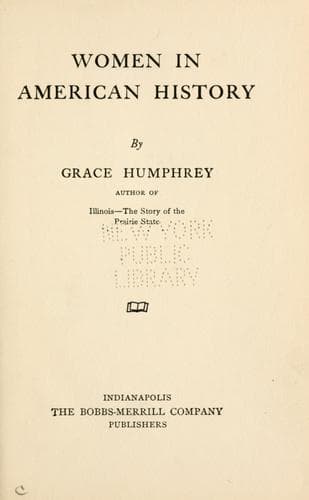
Women -- Biography; Women -- United States -- Biography
“I must get up and write it down, lest I fall asleep again and forget
it,” she said to herself. In the half light she groped for pen and
paper and scrawled the lines down, almost without looking--a thing she
had often done before, when verses came to her in the night. With the
words put down in black and white, safe from oblivion, she went to
sleep again, saying drowsily to herself, “I like this better than most
things I have written.”
The poem was published soon after in the _Atlantic Monthly_, but
aroused little comment. The war, with alternate victory and defeat,
engrossed public attention. Small heed could be paid to a few lines in
a magazine.
But an army chaplain in Ohio read it, liked it, and memorized it before
putting down the _Atlantic_. Captured at Winchester, where he had
delayed to help the doctors with the wounded, this chaplain was sent
to Libby Prison, in Richmond. One large, comfortless room the Union
men had, with the floor for a bed. The Confederate officer in charge
told them one night that the South had just had a great victory; and
while they sat there in sorrow old Ben, a negro who sold them papers,
whispered to one prisoner that this news was false, that Gettysburg had
been a great defeat for the South.
The word passed like a flame. Men leaped to their feet, and broke into
rejoicings. They shouted and embraced one another in a frenzy of joy
and triumph. And the fighting Chaplain McCabe, standing in the middle
of that great room, lifted up his fine baritone voice and sang, “Mine
eyes have seen the glory of the coming of the Lord.” Every voice took
up the chorus and “Glory, glory hallelujah, our God is marching on,”
rang through Libby Prison. You can imagine the effect of the tremendous
uplift of the lines.
Released, the fighting chaplain began work for the Christian Commission
and gave a lecture in the hall of representatives in Washington.
As part of his recent experiences he told this incident of their
celebration of the battle of Gettysburg, and ended by singing Mrs.
Howe’s poem, as only the man who had lived it could sing it. The great
audience was electrified. Men and women sprang to their feet and wept
and shouted. Above the wild applause they heard the voice of Abraham
Lincoln calling, while the tears rolled down his cheeks, “Sing it
again!”
McCabe sang it and the nation took up the chorus. The story of this
lecture made the hymn popular everywhere. It was sung in all the homes
of the North, at recruiting meetings and rallies. The troops sang it in
bivouac at night, and on the march. The Union army seized on it as its
battle cry and sang it as they went into action.
Public-domain text, read in full here on John Shaqi.
Reviews
Reviews
No reviews yet
Be the first to share your thoughts on this work.
Elsewhere in the archive
Join the Discussion
Join the discussion
Sign in to leave a comment or review.
Sign InorCreate an account