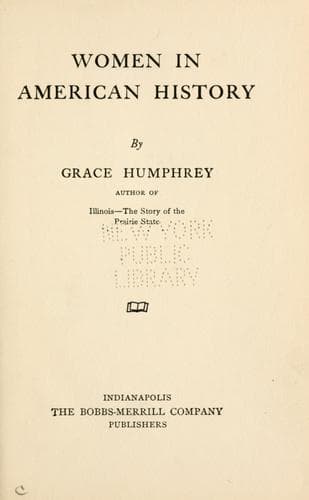
Women -- Biography; Women -- United States -- Biography
She served as principal in a Massachusetts high school for the next
three years, and resigned to marry Doctor Livermore, a young minister
whose church was near the school. She assisted in his parish work; she
started benevolent and literary and temperance societies among the
church-members; and she helped her husband edit a religious paper,
after they moved to Chicago. She frequently wrote stories and sketches
for eastern magazines, and she sat at the press table in the “Wigwam”
when Lincoln was nominated for the presidency in 1860. With her
writing, her three children, and a quiet, happy home life, doing the
common duties of every day, it seemed impossible that Mary Livermore
would ever be helping to make American history.
But Lincoln was elected, Sumter was fired on, the nation plunged into
civil war, the president called for volunteers.
Summoned to Boston by her father’s illness, Mrs. Livermore was in
the station when the Massachusetts troops started south. The streets
were crowded, the bells rang, the bands played. Women smiled and said
good-by when their hearts were breaking. After the train had pulled out
several women fainted and Mrs. Livermore stayed to help them.
“He has only gone for three months, you know,” she said to one little
mother.
“If my country needs him for three months or three years, I’m not the
woman to hinder him,” was the brave reply. “When he told me at noon
to-day he’d enlisted I gave him my blessing and told him to go, for if
we lose our country, what is there to live for?”
Seeing such partings Mary Livermore could not rest. She had no sons to
send. What could women do to help?
“Nothing,” was the answer from Washington when they offered their
services; “there is no place for women at the front, no need for them
in the hospitals.”
The outbreak of the war found the North wholly unprepared. Hospitals
were few and poorly equipped, nurses scarce and not well trained; there
were no diet kitchens, no organized ways to supply medicines to the
sick, to care for the wounded. Taxed to the utmost in every direction,
the government could not meet all the urgent demands for hospital
supplies. Relief societies sprang up everywhere, working individually,
sending boxes to the troops from their special localities.
But what a waste in that haphazard method! Perishable freight
accumulated till it was a serious problem. Baggage cars were flooded
with fermenting sweetmeats and broken jars of jelly. Decaying fruit
and demoralized cakes were found packed in with clothing and blankets.
The soldiers were constantly moving about and many packages failed of
delivery. The lavish outpouring of the generous people of the North
meant for a time a lavish waste. If the men’s answer to Lincoln’s call
was unparalleled, no less remarkable was the response of the women; but
it needed to be systematized and organized like a great business. That
was Mary A. Livermore’s contribution to saving the Union.
Public-domain text, read in full here on John Shaqi.
Reviews
Reviews
No reviews yet
Be the first to share your thoughts on this work.
Elsewhere in the archive
Join the Discussion
Join the discussion
Sign in to leave a comment or review.
Sign InorCreate an account