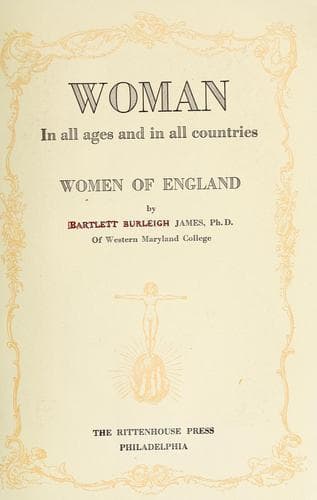
Women -- England -- History; Women -- Great Britain -- History
Perhaps at no other time in English history have ladies shown such
fondness for pets as in the fifteenth century. There are frequent
references to them in the literature of the day, and they appear in
many of the illustrations; parrots, magpies, jays, and various singing
birds are often mentioned among domestic pets. Various kinds of small
animals were also tamed and kept in the house, either loose or in
cages, squirrels being especially in favor because of their liveliness
and activity. Gambling was one of the most popular vices of the day.
It was not until after the middle of the fifteenth century that cards
came into very general use, but by the beginning of the following
century card playing had passed from the stage of fad and become a
passion. After the table was removed, one of the servants would bring
in a silver bowl full of dice and cards, and the company would be
invited to play. So general and widespread was the practice that early
in the reign of Henry VIII. an attempt was made to restrict the use
of cards to the Christmas holidays. Women were hardly less inveterate
devotees of this and other games of chance than the men, although
it is not to be concluded that they took such games as seriously or
risked as large sums as did the other sex. Dinner was served at noon,
and the games, along with dancing, usually occupied the time of the
leisure classes until supper, which seems to have been served at six
o'clock. There was, of course, no other form of amusement that was so
well adapted to polite circles, or that could be participated in with
as much pleasure by the ladies, as dancing. Many new dances had been
introduced and become fashionable, and these were much more lively
than those of the earlier period, some so spirited, indeed, as to
scandalize the moralists of the time. After supper the amusements were
resumed, and continued until a late hour, when a second, or, as it was
called, a "rere-supper," was served.
After the members of the household and the guests were surfeited
with amusements, or the lateness of the hour made sleep welcome, they
retired to rest in the upper chambers. These bedrooms were much more
private than they had formerly been. In the poem _Lady Bessy_, when
the Earl of Derby is represented as plotting with Lady Bessy in aid of
the Earl of Richmond, he tells her that he will repair secretly to her
chamber:
"'We must depart (separate), lady,' the earl said then;
Wherefore, keep this matter secretly,
And this same night, betwixt nine and ten,
In your chamber I think to be.
Look that you make all things ready,
Your maids shall not our councell hear,
For I will bring no man with me
But Humphrey Brereton, my true esquire.'
He took his leave of that lady fair,
And to her chamber she went full light,
And for all things she did prepare,
Both pen and ink, and paper white."
Public-domain text, read in full here on John Shaqi.
Reviews
Reviews
No reviews yet
Be the first to share your thoughts on this work.
Elsewhere in the archive
Join the Discussion
Join the discussion
Sign in to leave a comment or review.
Sign InorCreate an account