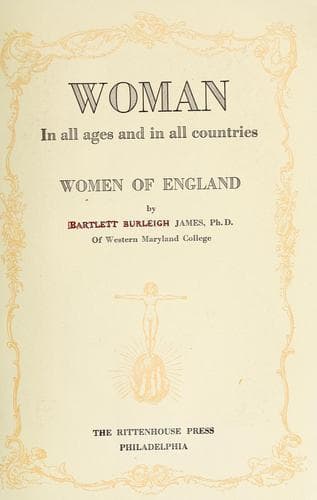
Women -- England -- History; Women -- Great Britain -- History
Among savage peoples, as the primitive tribes of Africa and the
American aborigines, the man who can dispel disease by a fetich--the
great medicine-man of a tribe--has always been regarded with a feeling
of combined jealousy, suspicion, and fear; but, because of the occult
powers he is supposed to control, fear predominates and passes into a
form of reverence. Not so, however, in the case of woman, of whom
we write; she was looked upon as having forfeited, to an extent, her
claims upon humanity by her original alliance with Satan, and, being
outside of the pale of God's grace, or sustaining only a permissive
relationship to it, it was deemed a pious, a safe, and a creditable
thing to mete out to her the divine dispensation of wrath. Thus again,
amid numerous instances of woman's suffering as a penalty for her sex,
we have the occurrence of woman being persecuted unto death because of
her compassion. It was not regarded as despicable for the very person
who had been succored by her in the hour of sickness to turn informant
and declare that he or she had been healed by diabolical agency, and,
whether under the influence of an honest hallucination, or simply
actuated by a malicious propensity, to declare that evil spirits had
actually been conjured up in human form and been seen by the eyes of
the sufferer.
Women were not blameless in the matter of their reputation for
possessing occult knowledge and having diabolical relations; for there
were many women who, being morally not beyond reproach, separated
themselves from society as they grew older, and resorted to medicinal
knowledge and magic for a living and to maintain in the public eye
the position of unenviable notoriety of which they had become
morbidly fond. It gratified such natures to be reputed to possess
the power--which even philosophers ascribed to them--of, at certain
seasons, turning milk sour, making dogs rabid, and producing other
such freakish manifestations. They were considered to be able not only
to heal sickness, but to cause it; and the presence in one's clothing
of a pin whose irritant end was pointed in the wrong direction was
sufficient to make the person believe that he was under a spell of
witchcraft. If a cow or a horse fell lame, it was the village witch
who did it; if a child developed as an imbecile, or anyone became
bereft of reason, it was laid at the door of the witch; the failure
of crops, a drought,--anything that interfered with the comfort
or convenience of a person or a community,--was due to some such
representative of Satan.
Public-domain text, read in full here on John Shaqi.
Reviews
Reviews
No reviews yet
Be the first to share your thoughts on this work.
Elsewhere in the archive
Join the Discussion
Join the discussion
Sign in to leave a comment or review.
Sign InorCreate an account