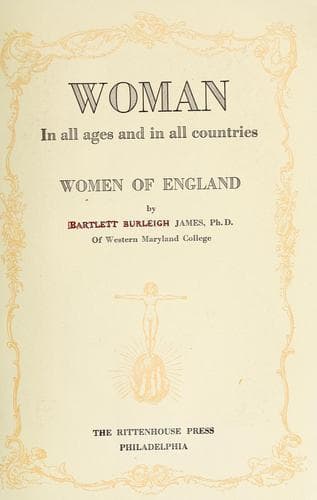
Women -- England -- History; Women -- Great Britain -- History
The artificiality of eighteenth-century society was a precursor of the
practicality of that of the nineteenth. The influences which had given
shape to the society of the time of the Stuarts had passed away, and
the new influences and forces were in operation. The result of the
contest between the Puritan and the sensualist had been a broadened
social apprehension; and into this new concept entered harmoniously
the catholicity of the worldly spirit and the conservatism of the
religious spirit. This was the society which was productive of
women of eminence in the arts and literature, as well as of women
untalented, but blessed with a broader scope of life, more varied
experience and controlled natures, than those who had gone before
them.
Society as a whole indirectly profited by the English dalliance
with French manners. Corruption was but a circumstance of the closer
relationship, in social ways, of England with the continent. Political
animosities and ambitions had more largely than anything else brought
England and the rest of Europe into contact, nor was the contact by
clashing at an end. A nation generally is not greatly concerned in
the projects of princes, so that, while territorial aggrandizement or
curtailment or similar benefits or injuries resulted from the wars
of England, the salient fact as a social consideration is that the
English people were still further broadened from the provincialism
which the insularity of their country induced. At the beginning of
the eighteenth century, the women of England had escaped the local and
narrow spirit and separateness of customs which threatened them from
England's beginning, and from which they were saved by recurrent and
ever more frequent contact with continental nations.
English society, however, had not become so imbued with the
cosmopolitan spirit as to feel at ease in it as in a loose garment;
the people were straitened and formal. They were lacking the
versatility and adaptability which developed in the nineteenth
century, when, amongst women, convention became settled custom, and
custom the careful promulgator of social laws. There were present all
the evidences of the finer sensibilities which give clear notions in
matters intellectual, and society in the last half of the eighteenth
century became thoroughly aroused to a social consciousness with
regard to the middle and lower classes. The industrial revolution and
the rise of the school of classic economists brought forward great
discussions which had for their purpose the determination of the
fundamental basis of a nation's prosperity. Into this discussion women
entered as participants, but very much more largely as interested
subjects of the matters involved.
Public-domain text, read in full here on John Shaqi.
Reviews
Reviews
No reviews yet
Be the first to share your thoughts on this work.
Elsewhere in the archive
Join the Discussion
Join the discussion
Sign in to leave a comment or review.
Sign InorCreate an account