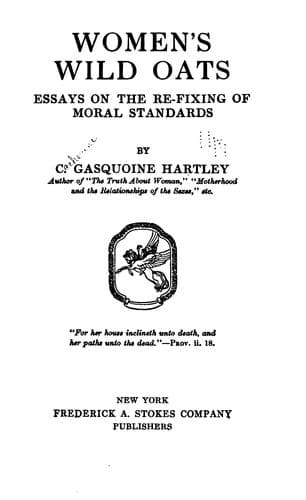
Women's Wild Oats: Essays on the Re-fixing of Moral StandardsHartley, C. Gasquoine (Catherine Gasquoine)
History
Women's Wild Oats: Essays on the Re-fixing of Moral Standards
Hartley, C. Gasquoine (Catherine Gasquoine)
Women -- Great Britain; Women -- Social and moral questions
Is the evil to remain uncorrected from one generation to another? That
is the question. Uncorrected evil multiplies itself, and the sum is a
huge national disaster. I wish passionately that I had greater powers to
make you see what to me is so plain. The mistake has been the
muddle-headed thinking that sets apart these diseases from all other
sicknesses of our bodies, obscuring the plain and comparatively simple
question of cure with the entirely opposed problem of punishment; a
confusion and losing of the way that leads inevitably into a
forest-tangle of difficulty and unanswerable questions. And this
heritage of wrong-thinking has compassed our feet, binding them and
throwing us down, as soon as we try to move on, always hindering reform
from generation to generation, and, until that entanglement is broken
through, by bringing into it the light of honest thinking, the evil will
go on, unchecked by our futile tearings here and there at withered
branches. The supporting stem will continue to flourish and the
devastating diseases will be spread.
(See Sir G. Archdall Reid's letter in Appendix.)
FOOTNOTES:
[117:1] See Ed. Carpenter, "Civilisation: Its Cause and Cure."
[129:1] The Conference was held in the ball-room of the Club of the
Allied Officers at Cannes.
[129:2] In this connection, it should be noted that there was a time
when syphilis was unknown in our civilisation. It cannot be traced with
any certainty in Europe before the fifteenth century, although its
origin is involved in some controversy. The attempt to suppress venereal
diseases by proper treatment is of little more than twelve years
duration. Three men--Wassermann, Ehrlich, and Noguchi--have supplied the
knowledge whereby the evil may be attacked. See "Motherhood and the
Relationship of the Sexes," p. 283, _et seq._
[132:1] "The Fight against Venereal Disease," by Raymond B. Hodick, _The
New Republic_, Nov. 30, 1918.
[134:1] My own opinions have been greatly influenced by what has been
done in England with regard to drink, and in the American Army in
maintaining the health of the Army by restricting prostitution, which
explains a change in my attitude, since writing the chapter on
"Prostitution" in _The Truth about Woman_.
[141:1] On this question the testimony of the American Army is urgent.
They say, "Prophylaxis is under favorable circumstances secondary only
in effectiveness to actual prevention of exposure.... When every other
means have been used to make contact difficult if not impossible,
prophylaxis, while not one hundred per cent. efficient, is invaluable as
a last resort, and has contributed a large share towards maintaining in
our Army the lowest venereal disease rate ever before known." Article
before cited.
_Fifth Essay_
IF A CHILD COULD CHOOSE?
A PLEA FOR PROTECTION FOR THE ILLEGITIMATELY BORN CHILD.
"I have called and ye refused; I have stretched out my hand
and no man regarded."--Pro. i. 24.
I
Public-domain text, read in full here on John Shaqi.
Reviews
Reviews
No reviews yet
Be the first to share your thoughts on this work.
Elsewhere in the archive
Join the Discussion
Join the discussion
Sign in to leave a comment or review.
Sign InorCreate an account