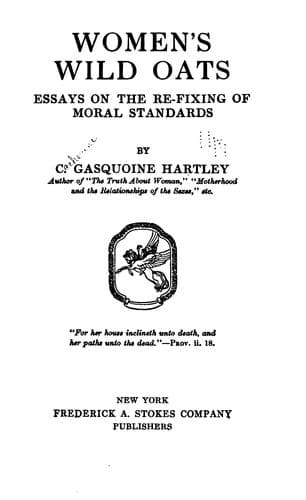
Women's Wild Oats: Essays on the Re-fixing of Moral StandardsHartley, C. Gasquoine (Catherine Gasquoine)
History
Women's Wild Oats: Essays on the Re-fixing of Moral Standards
Hartley, C. Gasquoine (Catherine Gasquoine)
Women -- Great Britain; Women -- Social and moral questions
A further difficulty, very pressing at the present time, arises from the
fact that the supply of reliable foster-mothers has diminished
everywhere, especially in London and the large cities. Even where women
suitable for this purpose are still attainable, the weekly sum asked for
the child's keep is so high that in spite of increased wages and the
raising from 5/- to 10/- of the maximum amount allowed against the
father under an affiliation order, few mothers can afford to pay it and
live decently themselves. The bitter cry of the driven mother frequently
is, "Help me to get rid of my baby."
We have demanded too much from the unmarried mother. As a rule she is
very young. She is faced with an almost impossible task, and often she
is weak in character, incapable, without guidance of so difficult a duty
as the up-bringing of the little creature she has helped so greatly to
wrong by its very birth.
III
For let no one make a mistake. There is a sin of illegitimacy, which,
indeed, I would emphasize as strongly as I am able. Irresponsible
parenthood must always be immoral, and the mother's sin is greater than
is that of the father. I must insist upon this, though I realize how
unpopular such a view will be to many women. But the mother, through her
closer connection with the child, must bear the deeper responsibility
for its birth, a responsibility that can be traced back and back to the
very lowest forms of life. The insect mother does not fail to place her
offspring--the children she will never see--in a position chosen most
carefully to ensure their future protection, and to achieve this good
frequently she sacrifices her life. Shall the human mother, then, be
held guiltless when she shows no forethought for the future of her
child?
IV
The English law has always looked with great disfavor on the
illegitimately born child. A bastard is _filius nullius_, "nobody's
child." He cannot be legitimized even on the subsequent marriage of his
parents. In Scotland this injustice is not found. There (as also in
every other civilized land except our own) the child becomes legitimized
by the simple natural process of the father marrying the mother. Can the
cruelty of our English law have any positive value? It is difficult to
think so. At common law the illegitimate can have no guardian, he has no
relations and no rights of inheritance; he is given unprotected into the
custody of his mother, and until the age of fourteen is wholly in her
power.
Public-domain text, read in full here on John Shaqi.
Reviews
Reviews
No reviews yet
Be the first to share your thoughts on this work.
Elsewhere in the archive
Join the Discussion
Join the discussion
Sign in to leave a comment or review.
Sign InorCreate an account