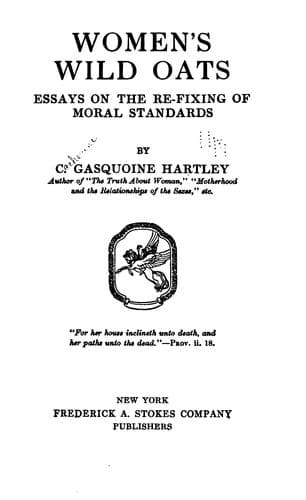
Women's Wild Oats: Essays on the Re-fixing of Moral StandardsHartley, C. Gasquoine (Catherine Gasquoine)
History
Women's Wild Oats: Essays on the Re-fixing of Moral Standards
Hartley, C. Gasquoine (Catherine Gasquoine)
Women -- Great Britain; Women -- Social and moral questions
It is to be wished that this question also could be approached free from
all falseness of modern feminist sentimentality. The great hindrance to
straight thinking is the same here as in so many other of the moral
problems we have been considering: that desire for personal possessions,
which so often is a treachery against the universal good. I care for
nothing really except the saving of the child, and I cannot regard the
child as the possession of the mother. So many women seem to take for
themselves the right to claim power over a child by virtue of the
suffering through which they passed to bring it into the world; although
surely this should be denied when conception takes place carelessly and
without any kind of forethought for the birth that may follow. I will
not, however, wait to say more, my position will, I hope, become plainer
as I proceed. _It is an assertion of the child's right to special
protection and care in order that it may be saved from the cruel
injustice of having to pay the penalty of its mother's carelessness and
lack of maternal responsibility._[161:1]
VI
Since the law of 1834 a woman has been legally liable to maintain her
natural child until it reaches the age of sixteen. She is allowed to
establish paternity, and, if she can do this, to obtain a maintenance
order against the father, the maximum amount now allowed being 10/- a
week, which sum is to be paid until the child reaches the age of
sixteen. But the mother is not compelled to take this course, indeed,
she is hindered from doing so in every possible way, both by the many
absurd difficulties of the law and the expense of the summons. And this
is the cause of clear injustice to the child, whose right to a father
and to support from him ought not to be dependent on the caprice of the
mother, whose desire is often to protect the man rather than to do
justice to the child. For this reason the establishment of paternity
should be compulsory on the mother or her relations as it now is in
Norway. Every child has a right to a father as well as to a mother.
The ante-natal conditions of these babies are obviously of the very
worst. All those months when a woman most requires special rest, special
quiet, and, in particular, special mental repose, will be spent in
anxiety and fear. In too many cases the girl has to keep herself, and it
is mighty difficult to get a job without a character. And, here, let me
point out to those who believe vaguely that a "love-child" is a finer
type than other children, that this is true only in so far as the
atmosphere in which the mother spends her pregnancy is one of love and
undisturbed calm. Do let us face the facts of the situation.
Public-domain text, read in full here on John Shaqi.
Reviews
Reviews
No reviews yet
Be the first to share your thoughts on this work.
Elsewhere in the archive
Join the Discussion
Join the discussion
Sign in to leave a comment or review.
Sign InorCreate an account