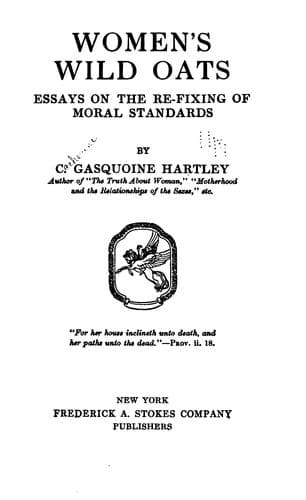
Women's Wild Oats: Essays on the Re-fixing of Moral StandardsHartley, C. Gasquoine (Catherine Gasquoine)
History
Women's Wild Oats: Essays on the Re-fixing of Moral Standards
Hartley, C. Gasquoine (Catherine Gasquoine)
Women -- Great Britain; Women -- Social and moral questions
unsafe and so wrong of society to leave the child unprotected and
unwatched, for the mother to do with it what she likes.
The first case, because it shows so clearly the adverse action of the
mother's influence is, in my opinion, most instructive among the five
cases I have given. Such changeableness on the mother's part, and
interference with the child is just what is likely, and most often does
take place, and will go on taking place, until the law protects these
children by effective guardianship. I would specially point out that
this mother was not in the least indifferent to her baby. If you had
talked to her, probably your sentiment would have burned and glowed
about the hardness of her case in being separated from her baby, and
you would have said wonderful platitudes about the beauty of a mother's
love. And yet the shameful hurt she did to her child can never be
undone. Her undisciplined love was the cause of the child's undoing.
I have now, I hope, made it sufficiently plain why the illegitimately
born child should no longer be considered as belonging to the mother,
but should be recognized as a member of society, and, as such, entitled
to protection, so that it may suffer as little, and not as much, as is
possible from the disadvantages of its illegal birth. This is plain
justice. Yet before it can be done we shall need an immediate and great
reform of our bad and antiquated bastardy and affiliation laws. We shall
need also a change of heart.
XII
I shall be asked what changes I would suggest. The answer is not easy:
it is not so much a question of altering this regulation or that, of
removing hindrances and giving increased help; that is good, but more is
needed: we want a change of the entire system: _the firm understanding
that the clear aim before us is to place the child, as nearly as this
can be done, in the same position of advantage as it would have had if
it had not been illegally born. If there must be punishments, let them
fall on the parents, never on the child._
Now, how can this best be done? In the space I can devote here, it is
possible only to throw out a few suggestions.
First, and I think exceedingly important, the law should take account of
the attitude of the father. In all cases where the paternity of the
child is acknowledged openly by the man and with the mother, and
guarantees are given that the duties of both parents will be faithfully
fulfilled, the child should be legitimized, receive the name of the
father, be qualified to inherit from him, and in every way given the
same rights as the legitimate child, even if the parents are unable or
do not wish to marry. This opportunity of right conduct once given to
men by the law, I believe that many, who are fathers illegitimately,
would voluntarily take this course and gladly acknowledge and fulfill
the responsibilities of their fatherhood.
Public-domain text, read in full here on John Shaqi.
Reviews
Reviews
No reviews yet
Be the first to share your thoughts on this work.
Elsewhere in the archive
Join the Discussion
Join the discussion
Sign in to leave a comment or review.
Sign InorCreate an account