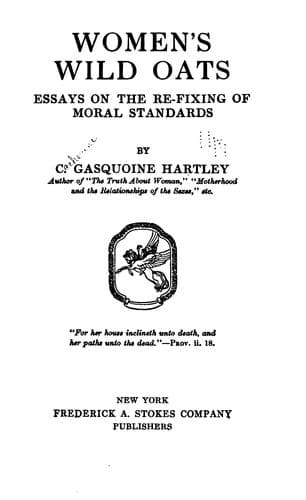
Women's Wild Oats: Essays on the Re-fixing of Moral StandardsHartley, C. Gasquoine (Catherine Gasquoine)
History
Women's Wild Oats: Essays on the Re-fixing of Moral Standards
Hartley, C. Gasquoine (Catherine Gasquoine)
Women -- Great Britain; Women -- Social and moral questions
But that is not to say we are to push them into dangers. I believe we
make the way too hard for the young with much of our nonsense about
liberty and not interfering. You know what happens in a garden where the
gardener does interfere with his hoe? I have been forced back, often
reluctantly, into accepting the necessity of boundaries. I want right
conduct to be defined, and defined widely with possible paths, so that
the young may have a chance of finding their way.
We have, I am sure, to set up new conventions, establish fresh sanctions
and accept prohibitions, to rebuild our broken ramparts and render safe
and pleasant the city within. Do we fail to do this, we leave the young
to stumble among the ruins we have made. And do not let us be hypocrites
and profess surprise when they fall. The knowledge we are forcing on
them, often against their desire, will not save them. With all our
efforts we can but teach them intellectually; a form of knowledge,
which shatters like thin glass, with a very slight blow, when it comes
in contact with the emotions. Thus I am driven back to the truth,
established already in an earlier essay, that the one sure way to
deliver the young from evil is to lessen their temptations.
You see hidden sin is always more attractive than open sin; for one
thing, it is easier to begin, and the beginning of sin is usually
drifting; secrecy also supplies adventure, and the excitement that is
desired by the young so passionately in the dullness of life.
IV
There never was an age when so many diverse types of young women
flourished, sometimes they are rather puzzling to the middle-aged
observer.[200:1] With so many of them there is a kind of forced levity,
a self-consciousness that prevents them from being either simple or
serious. All the clever ones seem to think that by talking in
generalizations, you can avert the plain issues of life. Their
conversation is full of meaningless remarks, such as "the bondage of
sex," "the superstition of chastity," "freedom in the marriage bond,"
"the sacrifice of women," "stifling convention," and so on, which they
go on repeating because that is the terminology of their set. They have
no conception of realities at all, only of abstract situations.
Impossible to tell what are their pseudo-emotions; a sort of sterile
intellectualism, shown in their shirking of sex responsibility. They
wish to ignore the real difficulty of marriage; they accept love, but
only with conditions. The one thing they face practically is work, and
the two activities don't conflict in their estimates, because their
minds are too choked with conceptions to admit facts. They are faithful
to their training by G. Bernard Shaw and H. G. Wells, in thinking that
by stating a situation and arguing about it, you can shirk the need of
dealing with it.
Public-domain text, read in full here on John Shaqi.
Reviews
Reviews
No reviews yet
Be the first to share your thoughts on this work.
Elsewhere in the archive
Join the Discussion
Join the discussion
Sign in to leave a comment or review.
Sign InorCreate an account