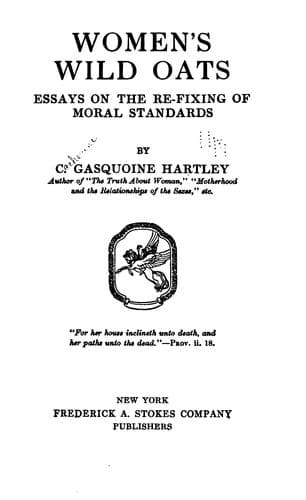
Women's Wild Oats: Essays on the Re-fixing of Moral StandardsHartley, C. Gasquoine (Catherine Gasquoine)
History
Women's Wild Oats: Essays on the Re-fixing of Moral Standards
Hartley, C. Gasquoine (Catherine Gasquoine)
Women -- Great Britain; Women -- Social and moral questions
Now, the moralist, who does not face facts, would have them all marry.
Certainly this is an easy way to settle the matter, but is it wise? is
it even right? Moreover, even if this were possible and there was no
surplus of women, would this solution be acceptable to these women? I am
doubtful if it would. _Many of them who want a lover do not want a
husband_, they make a surprisingly clear distinction between the two.
There is, as I have before said, a hardly-yet-realized change in woman's
attitude: they are beginning to take the ordinary man's view of these
affairs,--to regard them as important and providing interest and
pleasure, but not to be exaggerated into tragedies. They deliberately
want to keep love light and dread the bondage of any deep emotions.
Now, such an attitude is not good for marriage, and, indeed, there can
be no manner of use in forcing into the marriage bonds those who are
unwilling to accept its duties of permanent devotion. Some other way,
more practical and more helpful, must be found. We shall have, I am
convinced, to broaden our views on this question of passionate
friendships between women and men, to reconsider the whole position of
sexual relationships apart from marriage, in order to decide what may be
permitted, to regulate conduct and fasten responsibility, to open up in
the future new ways of virtue. And in attempting, thus, to face squarely
the difficult situations before us, I can find only one clear simple and
honest way to act.
VII
We come, then, to this: how can the way be made plainer for those women
and also men who are unsuited for marriage and do not wish to devote
their lives to its duties?
I believe that if there were some open recognition of honorable
partnerships outside of marriage, not necessarily permanent, with proper
provision for the future, guarding the woman, who, in my opinion, should
be in all cases protected; a provision not dependent on the generosity
of the man and made after the love which sanctioned the union has
waned, but decided upon by the man and the woman in the form of a
registered contract before the relationship was entered upon, then there
would everywhere be women ready to undertake such unions gladly, there
would, indeed, be many women, as well as men, who, for the reasons I
have shown, would prefer them to marriage.
Public-domain text, read in full here on John Shaqi.
Reviews
Reviews
No reviews yet
Be the first to share your thoughts on this work.
Elsewhere in the archive
Join the Discussion
Join the discussion
Sign in to leave a comment or review.
Sign InorCreate an account