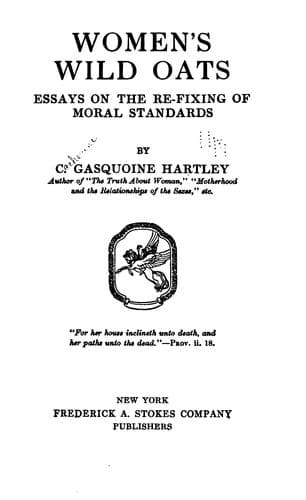
Women's Wild Oats: Essays on the Re-fixing of Moral StandardsHartley, C. Gasquoine (Catherine Gasquoine)
History
Women's Wild Oats: Essays on the Re-fixing of Moral Standards
Hartley, C. Gasquoine (Catherine Gasquoine)
Women -- Great Britain; Women -- Social and moral questions
Surely it is the wisest arrangement for the man and woman worker who do
not want children, and, not wishing for the bondage of a continuous
companionship, desire to pass their lives in liberty. It is possible
that in some cases such friendship-contracts might serve as a
preliminary to marriage, while, under our present disastrous conditions,
they might also be made by those who are unsuitably mated and yet are
unable, or do not wish, to sever the bond with some other partner. Such
contracts would open up possibilities of honorable relations to many who
now are driven into shameful and secret unions.
In this way much evil would be prevented. As time went on, hasty
marriage would come to be looked on with disapproval, and many unions
would be prevented that now inevitably come to disaster. And this would
leave greater chances of marriage and child-bearing for others and more
suitable types; while further, these sterile unions would, by their
childlessness, act to remove for ever from the world those unsuited to
be parents. It is this last result that matters most.
XI
The whole question of any sexual relationships outside of marriage in
the past has been left in the gutters, so to speak, of necessity made
disreputable by the shames of concealment. Much of this would be
changed. Moreover, prostitution, and also the diseases so closely
connected with prostitution, would be greatly lessened, though I do not
think sexual sins would cease. There will always be, for a very long
time at least, men and women who will be attracted to wild-love. This we
have to recognize. No one, however, need be driven into the dark paths
of irresponsible love.
It is the results that have almost always followed these irregular
unions that have always branded them as anti-social acts. But
irresponsible conduct, such, for instance, as the desertion of women,
which is made easy by the condition of secrecy under which they now
exist, would be put an end to. And by doing this would follow another
and, perhaps, even greater gain. The recognition of these partnerships
would prevent the ostracism which even yet falls on the discarded
mistress. There are many women who dread this more than anything else. A
woman is hounded out of decent life, if the facts of her history become
known; honorable love is closed to her, too often she finds the easiest
and pleasantest life is that of the streets.
Public-domain text, read in full here on John Shaqi.
Reviews
Reviews
No reviews yet
Be the first to share your thoughts on this work.
Elsewhere in the archive
Join the Discussion
Join the discussion
Sign in to leave a comment or review.
Sign InorCreate an account