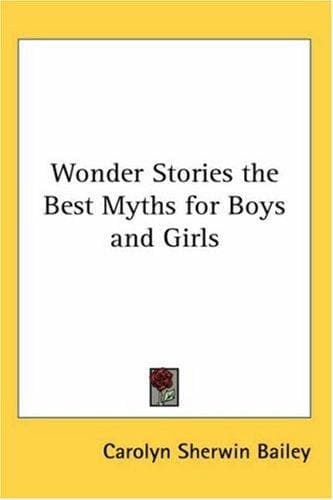
Wonder Stories: The Best Myths for Boys and GirlsBailey, Carolyn Sherwin
General
Wonder Stories: The Best Myths for Boys and Girls
Bailey, Carolyn Sherwin
Mythology, Classical -- Juvenile literature
That evening Hesperus, who followed in Aurora's course each sunset to
lead out the stars, saw the same goddess. Her robes were torn and
stained from her travels and bedraggled with the dew. She was still
weeping, and still searching. She was going to search, without rest, all
night.
Many others saw this goddess in the days that followed. She was always
roaming from daylight until dark, in the open, in sunlight and
moonlight, and in falling showers. She was weary and sad. In such a
plight a peasant, named Celeus, found her one day. He had been out in a
field gathering acorns and blackberries, and binding bundles of sticks
for his fire. The goddess sat there on a stone, too tired to go on.
"Why do you sit here alone on the rocks?" Celeus asked her. He carried a
heavy load, but he stopped to try and succor her. "Come to my cottage
and rest," he entreated her. "My little son is very ill, and we have
only a most humble roof, but such as it is we will be glad to share it
with you."
The goddess rose and gathered her arms full of crimson poppies. Then she
followed Celeus home.
They found deep distress in the cottage, for the little boy was so ill
as to be almost past hope. His mother could scarcely speak for her
sorrow, but she welcomed the wandering goddess and spread the table for
her with curds and cream, apples, and golden honey dripping from the
comb. The goddess ate, but her eyes were on the sick child and when his
mother poured milk into a goblet for him she mingled the juice of her
poppies with it.
At last night came, and the peasants slept. Then the goddess arose and
took the little boy in her arms. She touched his weak limbs with her
strong, skilful hands, said a charm over him three times, and then laid
him in the warm ashes of the fire.
"Would you kill my son? Wicked woman that you are to so abuse my
hospitality!" the child's mother cried, awaking and seeing what the
goddess had done.
But just then a strange thing happened. The cottage was filled with a
splendor like white lightning, and a light seemed to shine from the skin
of the goddess. A lovely perfume was scattered from her fragrant
garments, and her hair was as bright as gold.
"Your son will not die, but live," she told the wife of Celeus. "He
shall grow up and be great and useful. He shall teach men the use of the
plough, and the rewards which labor can win from the cultivation of the
soil."
"Who are you?" the woman asked in amazement as she saw the boy's white
cheeks grow rosy with new life.
"I am Ceres," the goddess answered, "whose grief is greater than yours,
for my child is lost. I search the earth for her, and never find her."
With these words she was gone, as if she had wrapped herself in a cloud
and floated away to meet the dawning of another day of her journey.
That was who this wanderer of the earth was, the immortal Ceres, who
still did not care to live without her loved little daughter,
Proserpine.
Public-domain text, read in full here on John Shaqi.
Reviews
Reviews
No reviews yet
Be the first to share your thoughts on this work.
Elsewhere in the archive
Join the Discussion
Join the discussion
Sign in to leave a comment or review.
Sign InorCreate an account