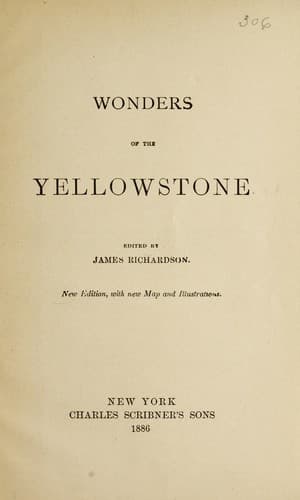
Wonders of the YellowstoneRichardson, James (Geologist)
History
Wonders of the Yellowstone
Richardson, James (Geologist)
Yellowstone National Park
Near its mouth the Upper Yellowstone is about half the size of the main
stream as it leaves the lake. Its valley is about three miles wide
and very marshy; all the little streams flowing down from the wooded
hill-slopes being obstructed by beaver-dams, so as to form continuous
chains of ponds. The sides of the valley are dark, sombre walls of
volcanic rock, which weathers into curious and imposing forms. Looking
up the valley from some high point, one almost imagines himself in
the presence of the ruins of some gigantic city, so much like ancient
castles and cathedrals do these rocks appear--a deception that is not
a little heightened by the singular vertical furrows cut deep into the
cliffs. At the base of the walls immense masses of breccia have fallen
from the mountain tops, in many instances cutting long swaths through
the pine forests. In the upper part of the valley, which in midsummer
is lush with vegetation, five streams flow down from the mountains
to swell the waters of the Yellowstone. These streams Colonel Barlow
calls, in honor of his commander's greatest victory, the Five Forks.
Here the valley terminates abruptly, the mountains rising like walls
and shutting off the country beyond. Just at the head of the valley is
a little lake, a hundred yards or so in width; the large lake which has
been placed on maps as Bridger's Lake having no existence. Dr. Hayden
with two assistants ascended the mountains to the west of the head of
the valley to survey the district bordering on the great divide. From
this point as far as the eye can reach on every side are bare, bald
peaks, domes and ridges in great numbers. At least one hundred peaks
worthy of a name can be located within the radius of vision. The rocks
everywhere, though massive, black, and deeply furrowed vertically, have
the appearance of horizontal stratification. In some instances the
furrows are so regular that the breccia has a columnar appearance. The
summits of the mountains are composed entirely of breccia, containing
angular masses of trachyte, from 10 to 30 feet in diameter, though most
of the fragments are small. Dr. Hayden's party camped at night near a
small lake, by the side of a bank of snow, 10,000 feet above the sea,
with short spring grass and flowers all around them. There are but two
seasons on these mountain summits, spring and winter; as late as August
fresh new grass may be seen springing up where a huge bank of snow has
just disappeared. Little spring-flowers, seldom more than two or three
inches high, cover the ground--_Clatonia_, _Viola_, _Ranunculus_, and
many others. The following morning they travelled for several miles
along a ridge not more than two hundred yards wide, from one side of
which the waters flow into the Pacific, and on the other, into the
Atlantic. To the westward the outlines of the Teton Range, with its
shark-teeth summits, are most clearly visible, covered with snow. From
whatever point of view, the sharp-pointed peaks of this range have
Public-domain text, read in full here on John Shaqi.
Reviews
Reviews
No reviews yet
Be the first to share your thoughts on this work.
Elsewhere in the archive
Join the Discussion
Join the discussion
Sign in to leave a comment or review.
Sign InorCreate an account