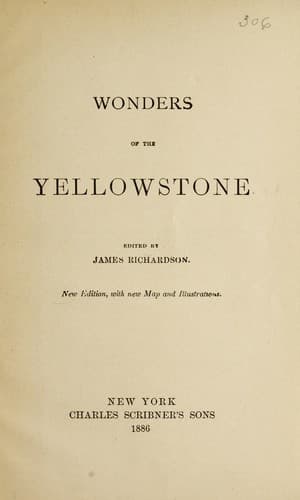
Wonders of the YellowstoneRichardson, James (Geologist)
History
Wonders of the Yellowstone
Richardson, James (Geologist)
Yellowstone National Park
The valley is filled with springs up to its very source; and springs
which burst from the mountain side, eight hundred feet above the level
of the basin, have temperatures ranging from 166° to 180°. Tracing one
exceptionally cool stream up the south side of the cañon, Dr. Hayden
found on the almost vertical side of the mountain a little spring so
imbedded in bright green moss that it could hardly be seen.
"With great difficulty," he says, "we managed to climb up the mountain
side, and, clearing away the moss, obtained the first water that we
could drink for eight hours. In all of our examination during the day
we had not found a drop of water of sufficiently low temperature to
take into our mouths, though there were hundreds of the most beautiful
springs all around us. We were like Coleridge's mariner in the great
ocean, 'Water, water everywhere, but not a drop to drink.'"
Looking back over the valley the morning before his departure for
the Upper Basin, Dr. Hayden saw it literally filled with columns of
steam, ascending from more than a thousand vents. "I can compare the
view," he writes, "to nothing but that of some manufacturing city like
Pittsburgh, as seen from a high point, except that instead of the black
coal smoke, there are here the white delicate clouds of steam. Small
groups or solitary springs that are scattered everywhere in the woods,
upon the mountain-sides, and which would otherwise escape observation,
are detected by the columns of steam. It is evident that some of
these groups of springs have changed their base of operations within
a comparatively recent period; for about midway on the east side of
the lower basin there is a large area covered with a thick, apparently
modern, deposit of the silica, as white as snow, while standing quite
thickly all around are dead pines, which appear to have been destroyed
by the excessive overflow of water and the increased deposition. These
dry trees have a most desolate look; many of them have fallen down
and are incrusted with the silica, while portions that have fallen
into the boiling springs have been reduced to pulp. This seems to be
one of the conditions of silicification, for when these pulpy masses
of wood are permitted to dry by the cessation of the springs, the most
perfect specimens of petrified wood are the result. In one instance a
green pine-tree had fallen so as to immerse its thick top in a large
hot basin, and leaves, twigs, and cones had become completely incrusted
with the white silica, and a portion had entered into the cellular
structure, so that when removed from the water, and dried in the
sun, very fair specimens were obtained. Members of my party obtained
specimens of pine cones that were sufficiently silicified to be packed
away among the collections."
Public-domain text, read in full here on John Shaqi.
Reviews
Reviews
No reviews yet
Be the first to share your thoughts on this work.
Elsewhere in the archive
Join the Discussion
Join the discussion
Sign in to leave a comment or review.
Sign InorCreate an account