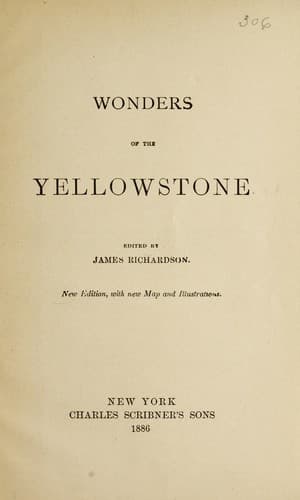
Wonders of the YellowstoneRichardson, James (Geologist)
History
Wonders of the Yellowstone
Richardson, James (Geologist)
Yellowstone National Park
Professor Tyndall's explanation is in substance this: Suppose that by
the entrance of steam from the ducts near the bottom of the tube the
geyser column is elevated six feet, a height quite within the limits
of actual observation; the water at A is thereby transferred to B.
Its boiling point at A is 255°, and its actual temperature is 251°;
but at B its boiling point is only 249°, hence when transferred from
A to B, the heat which it possesses is in excess of that necessary
to make it boil. This excess of heat is instantly applied to the
generation of steam; the column is thus lifted higher, and the water
below is relieved of pressure, and its boiling point lowered. More
steam is generated; this lifts the column still higher, and compels the
generation of more and more steam, until the whole upper portion of the
column bursts into ebullition, and the water, mixed with steam-clouds,
is projected into the atmosphere, and we have the geyser eruption in
all its grandeur.
One confirmation of this theory of Bunsen's is that small stones
suspended in the lower part of the geyser-tube are not thrown out
during an eruption; and a stronger confirmation lies in the fact that
all the peculiarities of geyser action can be imitated. Professor
Tyndall uses for this purpose an apparatus consisting of a tube of iron
six feet long, surmounted by a basin, and heated by fires underneath.
To imitate, as far as possible, the conditions of the geyser, he
encircles the tube with a second fire, two feet from the bottom. As the
water in the tube becomes heated, the phenomena of geyser eruption
are repeated in miniature with beautiful regularity. By stopping the
mouth of the tube with a cork, the enforced explosions of the Strokr
are reproduced; and by similar simple devices the action of all other
eruptive springs may be accurately imitated.
All through the Firehole Basin and around Yellowstone Lake are many
extinct geysers; sometimes, as in the case of Old Faithful, an active
geyser is surrounded by a number of deserted cones, the remains of
ancient "roarers." What occasions their decline? Earthquakes may, and
no doubt frequently do, derange their mechanism, as observed in the old
Strokr. But most of them probably die a natural death, from old age and
decrepitude.
Public-domain text, read in full here on John Shaqi.
Reviews
Reviews
No reviews yet
Be the first to share your thoughts on this work.
Elsewhere in the archive
Join the Discussion
Join the discussion
Sign in to leave a comment or review.
Sign InorCreate an account