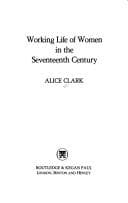
Working Life of Women in the Seventeenth CenturyClark, Alice
History
Working Life of Women in the Seventeenth Century
Clark, Alice
Women -- Employment -- Great Britain -- History -- 17th century; Women -- Great Britain -- History -- 17th century
The understanding and good sense which enabled women to assume control
during the temporary absence of their husbands, fitted them also to bear
the burden alone when widowed. Her capacity was so much taken for
granted that public opinion regarded the wife as being virtually her
husband’s partner, leases or indentures were made out in their joint
names, and on the husband’s death the wife was left in undisturbed
possession of the stock, apprentices and goodwill of the business.
A. _Skilled Trades or Crafts._
The origin of the Craft Gilds is obscure. They were preceded by
Religious Gilds in which men and women who were associated in certain
trades united for religious and social purposes. Whether these Religious
Gilds developed naturally into organisations concerned with the purpose
of trade, or whether they were superseded by new associations whose
first object was the regulation and improvement of the craft and with
whom the religious and social ceremonies were of secondary importance is
a disputed point, which, if elucidated, might throw some light on the
industrial history of women. In the obscurity which envelopes this
subject one certain fact emerges; the earlier Gilds included sisters as
well as brothers, the two sexes being equally concerned with the
religious and social observances which constituted their chief
functions.
As the Gilds become more definitely trade organisations the importance
of the sisters diminishes, and in some, the Carpenters for example, they
appear to be virtually excluded from membership though this exclusion is
only tacitly arrived at by custom, and is not enforced by rules. In
other Gilds, such as the Girdlers and Pewterers, it is evident that
though women’s names do not occur in lists of wardens or assistants, yet
they were actively engaged in these crafts and, like men, were subject
to and protected by the regulations of their Gild or Company.
Very little is yet known of the industrial position of Englishwomen in
the middle ages. Poll-tax returns show, however, that they were engaged
in many miscellaneous occupations. Thus the return for Oxford in 1380
mentions six trades followed by women, viz.—37 spinsters, 11 shapesters
(tailors), 9 tapsters (inn-keepers), 3 sutrices (shoemakers,) 3
hucksters, 5 washerwomen, while in six others both men and women were
employed, namely butchers, brewers, chandlers, ironmongers, netmakers
and kempsters (wool-combers). 148 women were enrolled as ancillæ or
servants, and 81 trades were followed by only men.
Public-domain text, read in full here on John Shaqi.
Reviews
Reviews
No reviews yet
Be the first to share your thoughts on this work.
Elsewhere in the archive
Join the Discussion
Join the discussion
Sign in to leave a comment or review.
Sign InorCreate an account