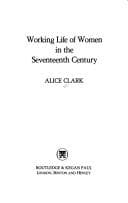
Working Life of Women in the Seventeenth CenturyClark, Alice
History
Working Life of Women in the Seventeenth Century
Clark, Alice
Women -- Employment -- Great Britain -- History -- 17th century; Women -- Great Britain -- History -- 17th century
The assistance of the wife was often so important in her husband’s
business, that she engaged servants to free her from household drudgery,
her own productive capacity being greater than the cost of a servant’s
wages. Apart from exceptional cases of illness or incompetence, the
share which the wife took in her husband’s business, was determined
rather by the question whether he carried it on at home or abroad than
by any special appropriateness of the said business to the feminine
disposition. Thus, though women were seldom carpenters or masons, they
figure as pewterers and smiths. In every business there are certain
operations which can conveniently be performed by women, and when
carried on at home within the compass of the family life, the work of a
trade was as naturally sorted out between husband and wife, as the work
on a farm. No question arose as to the relative value of their work,
because the proceeds became the joint property of the family, instead of
being divided between individuals.
With regard to the services which are now classed as professional, those
of healing and teaching were included among the domestic duties of
women. Illness was rife in the seventeenth century, for the country was
devastated by recurrent epidemics of small-pox and the plague, besides a
constant liability to ague and the other ordinary ailments of mankind;
thus the need for nursing must have been very great. The sick depended
for their tending chiefly upon the women of their own households, and
probably the majority of English people at this time, received medical
advice and drugs from the same source. Women’s skill in such matters was
acquired by experience and tradition, seldom resting upon a scientific
basis, for they were excluded from schools and universities. Acquired
primarily with a view to domestic use, such skill was extended beyond
the family circle, and women who were wise in these matters sometimes
received payment for their services. Midwifery alone was really
conducted on professional lines, and though practised in former days
exclusively by women, it was now passing from their hands owing to their
exclusion from the sources of advanced instruction.
Public-domain text, read in full here on John Shaqi.
Reviews
Reviews
No reviews yet
Be the first to share your thoughts on this work.
Elsewhere in the archive
Join the Discussion
Join the discussion
Sign in to leave a comment or review.
Sign InorCreate an account