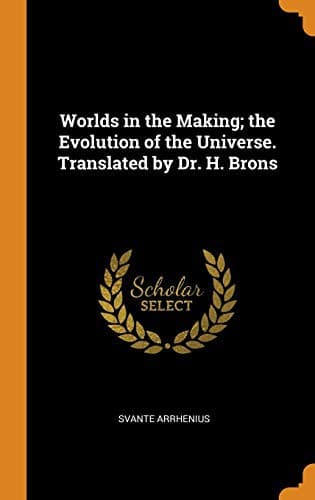
Worlds in the making: The evolution of the universeArrhenius, Svante
Science
Worlds in the making: The evolution of the universe
Arrhenius, Svante
Cosmogony
[Footnote 13: When, standing on a station platform, we watch
an express train rushing through the station, the pitch of the
engine whistle seems to become higher as long as the train
is approaching us, and deeper again when the train is moving
away from us. The pitch of a note depends upon the number of
oscillations which our ear receives per second. Now, when the
train is fast approaching us, more vibrations are sent into our
ear than when the train is at a stand-still, and the pitch,
therefore, appears to become higher. The same reasoning holds
for light waves, of which Doppler, of Prague (Bohemia), was in
fact thinking when first announcing his principle in 1842. The
wave-length of a particular color of the spectrum is fixed with
the aid of some Fraunhofer line characteristic of a certain
metal. If we compare the spectrum of a star and the spectrum of
a glowing metal, photographed on the same plate, the stellar
lines will appear shifted towards the violet end (violet light
is produced by nearly twice as many vibrations of the ether per
second as red light) when the star is moving towards us in the
line of sight. This principle has successfully been applied by
Huggins, H. C. Vogel, and others, for determining the motion
of a star in our line of sight. When a star is revolving about
its own axis, the equatorial belt will seem to come nearer to
us (or to recede from us), while the polar regions will seem to
be at a stand-still; the lines will then appear oblique (not
vertical). In this way Keeler proved that the rings of Saturn
consists of swarms of meteorites moving at different velocities
in the different rings.—H. B.]
Gradually the light of the metallic lines and of the continuous
spectrum on which they were superposed began to fade, first in the
violet, while the hydrogen lines and nebular lines still remained
distinct; like other new stars, this star showed, after a while, the
nebular spectrum. This interesting fact was first noticed by H. C.
Vogel in the new star in the Swan (Nova Cygni, 1876). The star P in the
Swan, which flashed up in the year 1600, still offers us a spectrum
which indicates the emission of hydrogen gas. It is not impossible
that this “new” star has not yet reached its equilibrium, and is still
continuing to emit cold streams of gases. Insignificant quantities
of gas suffice for the formation of an absorption spectrum; thus the
emission of gas might continue for long periods without exhausting the
supply.
Public-domain text, read in full here on John Shaqi.
Reviews
Reviews
No reviews yet
Be the first to share your thoughts on this work.
Elsewhere in the archive
Join the Discussion
Join the discussion
Sign in to leave a comment or review.
Sign InorCreate an account