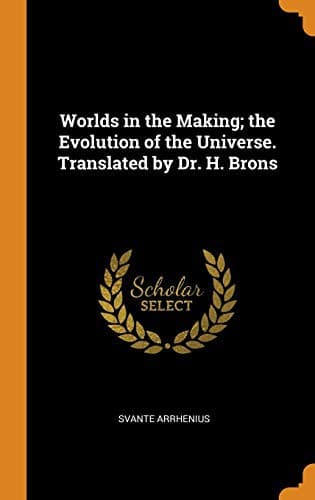
Worlds in the making: The evolution of the universeArrhenius, Svante
Science
Worlds in the making: The evolution of the universe
Arrhenius, Svante
Cosmogony
that the mass of the central sun in Mira Ceti will nearly equal the
mass of our sun. The calculation really suggests that Mira would be
about eight per cent. smaller; but the difference lies within the range
of the probable error.
Chandler has directed attention to a striking regularity in these
stars. The longer the period of their variation, the redder in general
their color. This is easily comprehended. The denser the original
atmosphere, the more widely the gases will have extended outward from
the star, and the more dust will have been caught or secreted by it. We
have seen that the limb of the sun has a reddish light because of the
quantities of dust in the solar atmosphere. The effect is chiefly to
be ascribed to the absorption of the blue rays by the dust; but it may
partly be explained on the assumption that the solar radiations render
the dust incandescent, though its temperature may be lower than that
of the photosphere, because the dust lies outside the sun, and that it
will therefore emit a relatively reddish light. The more dust there is
in a nebula, the redder will be its luminescence; and as the quantity
of dust increases in general with the extension of the nebula, that
star which is surrounded by wider rings of nebulæ will in general be
more red; but the greater the radius of the ring, the longer also will
in general be its period.
The so-called red stars show, in addition to the bright hydrogen lines,
banded spectra which indicate the presence of chemical compounds.
On this account such stars were formerly credited with a lower
temperature. But the same peculiarity is also observed in sun-spots,
although the latter, on account of their position, must have a higher
temperature than the surrounding photosphere. The presence of bands in
the spectrum certainly suggests high pressure, however. The red stars
are evidently surrounded by a very extensive atmosphere of gases, in
the inner portions of which the pressure is so high that the atoms
enter into combination. The spectra of the red stars display, on the
whole, a striking resemblance to those of the sun-spots. The violet
portion of the spectrum is weakened, because the masses of dust have
extinguished this light. Owing to the large masses of dust which lie
in our line of sight, the spectrum lines are in both cases markedly
widened and sometimes accompanied by bright lines.
Public-domain text, read in full here on John Shaqi.
Reviews
Reviews
No reviews yet
Be the first to share your thoughts on this work.
Elsewhere in the archive
Join the Discussion
Join the discussion
Sign in to leave a comment or review.
Sign InorCreate an account