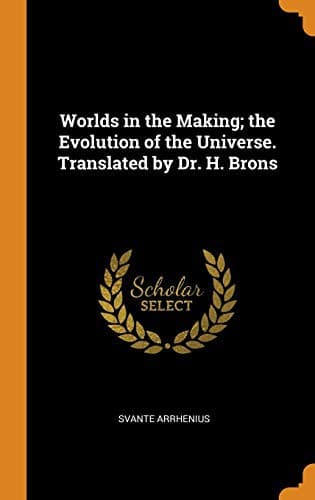
Worlds in the making: The evolution of the universeArrhenius, Svante
Science
Worlds in the making: The evolution of the universe
Arrhenius, Svante
Cosmogony
Although the latter verdict may be a little dogmatic, it yet
demonstrates how strongly many scientists feel the necessity of
finding another way of solving the problem. The so-called theory of
panspermia really shows a way. According to this theory life-giving
seeds are drifting about in space. They encounter the planets, and fill
their surfaces with life as soon as the necessary conditions for the
existence of organic beings are established.
This view was probably foreshadowed long ago. Definite suggestions in
this direction we find in the writings of the Frenchman Sales-Guyon de
Montlivault (1821), who assumed that seeds from the moon had awakened
the first life on the surface of the earth. The German physician H. E.
Richter attempted to supplement the doctrine of Darwin by combining the
conception of panspermia with it. Flammarion’s book on the plurality
of inhabited worlds suggested to Richter the idea that seeds had come
from some other inhabited world to our earth. He emphasizes the fact
that carbon has been found in meteorites which move in orbits similar
to those of the comets which wander about in space; and in this carbon
he sees the rests of organic life. There is no proof at all for this
latter opinion. The carbon found in meteorites has never exhibited any
trace of organic structure, and we may well imagine the carbon—_e.g._,
that which appears to occur in the sun—to be of inorganic origin.
Still more fantastic is his idea that organisms floating high in our
atmosphere are caught by the attraction of meteorites flying past
our planet, and are in this way carried out into universal space and
deposited upon other celestial bodies. As the surface of meteorites
becomes incandescent in their flight through the atmosphere, any germs
which they might possibly have caught would be destroyed; and if, in
spite of that, a meteorite should become the conveyor of live germs,
those germs would be burned in the atmosphere of the planet on which
they descended.
In one point, however, we must agree with Richter. There is logic
in his statement that “The infinite space is filled with, or (more
correctly) contains, growing, mature, and dying celestial bodies. By
mature worlds we understand those which are capable of sustaining
organic life. We regard the existence of organic life in the universe
as eternal. Life has always been there; it has always propagated itself
in the shape of living organisms, from cells and from individuals
composed of cells.” Man used to speculate on the origin of matter, but
gave that up when experience taught him that matter is indestructible
and can only be transformed. For similar reasons we never inquire into
the origin of the energy of motion. And we may become accustomed to the
idea that life is eternal, and hence that it is useless to inquire into
its origin.
Public-domain text, read in full here on John Shaqi.
Reviews
Reviews
No reviews yet
Be the first to share your thoughts on this work.
Elsewhere in the archive
Join the Discussion
Join the discussion
Sign in to leave a comment or review.
Sign InorCreate an account