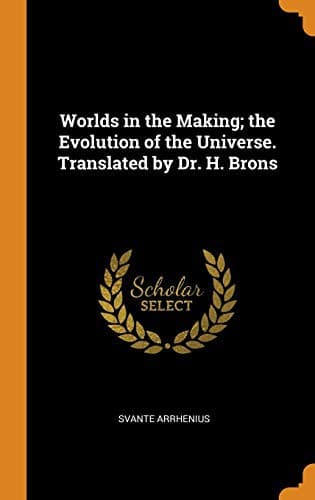
Worlds in the making: The evolution of the universeArrhenius, Svante
Science
Worlds in the making: The evolution of the universe
Arrhenius, Svante
Cosmogony
The seeds not caught by such particles of dust may be taken over to
other solar systems, and finally be stopped by the radiation pressure
of their suns. They cannot penetrate any farther than to spots at
which the radiation pressure is as strong as at their starting-points.
Consequently, germs from the earth, which is five times as near the sun
as Jupiter, could approach another sun within a fifth of the distance
at which germs from Jupiter would be stopped.
Somewhere near the suns, where the seeds are arrested by the radiation
pressure to be turned back into space, there will evidently be
accumulations of these seeds. The planets which circulate around their
suns have therefore more chance of meeting them than if they were not
in the vicinity of a sun. The germs will have lost the great velocity
with which they wandered from one solar system to another, and they
will not be heated so greatly in falling through the atmospheres of the
planets which they meet.
The seeds which are turned back into space when coming near a sun will
there perhaps meet with particles whose weight is somewhat greater than
the repelling power of the radiation pressure. They would, therefore,
turn back to the suns. Like the germs, and for similar reasons, these
particles would consequently be concentrated about the sun. The small
seeds have, therefore, a comparatively better chance of being arrested
before their return to space by contact with such particles, and of
being carried to the planets near that sun.
In this manner life may have been transplanted for eternal ages from
solar system to solar system and from planet to planet of the same
system. But as among the billions of grains of pollen which the wind
carries away from a large tree—a fir-tree, for instance—only one
may on an average give birth to a new tree, thus of the billions, or
perhaps trillions, of germs which the radiation pressure drives out
into space, only one may really bring life to a foreign planet on which
life had not yet arisen, and become the originator of living beings on
that planet.
Finally, we perceive that, according to this version of the theory
of panspermia, all organic beings in the whole universe should be
related to one another, and should consist of cells which are built up
of carbon, hydrogen, oxygen, and nitrogen. The imagined existence of
living beings in other worlds in whose constitution carbon is supposed
to be replaced by silicon or titanium must be relegated to the realm of
improbability. Life on other inhabited planets has probably developed
along lines which are closely related to those of our earth, and this
implies the conclusion that life must always recommence from its very
lowest type, just as every individual, however highly developed it may
be, has by itself passed through all the stages of evolution from the
single cell upward.
Public-domain text, read in full here on John Shaqi.
Reviews
Reviews
No reviews yet
Be the first to share your thoughts on this work.
Elsewhere in the archive
Join the Discussion
Join the discussion
Sign in to leave a comment or review.
Sign InorCreate an account