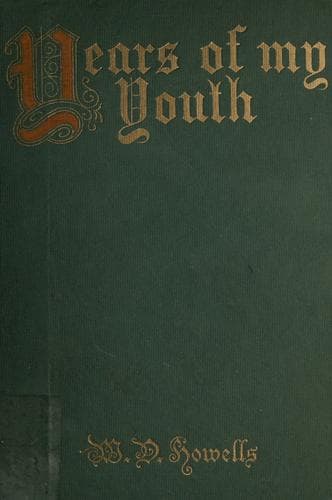
Howells, William Dean, 1837-1920 -- Childhood and youth
Of course there were some houses where such problems were of more
immediate and persistent interest than other houses. Such a house was
the ever-dear house of the S. family, which made itself a home any hour
of the day up to midnight for such youth as had once been adopted its
sons. It was not only a literary house, it was even more a musical
house, where there was both singing and playing, with interludes of
laughing and joking in all forms of seemly mirth, with the whole family,
till the little boys of it stumbled up the stairs half asleep. I could
not play, but I was sometimes suffered by that large-hearted hospitality
to try singing; and I could talk with the best. So, it was my more than
content in the lapses of the music to sit with the young aunt (she
seemed so mature in her later twenties to me in my earliest) and
exchange impressions of the books new and old that we had been reading.
We frequenters of the house held her in that honor which is the best
thing in the world for young men to feel for some gentle and cultivated
woman; I suppose she was a charming person apart from her literary
opinions; but we did not think of her looks; we thought of her wise and
just words, her pure and clear mind.
It was the high noon of Tennyson and Thackeray and George Eliot and
Dickens and Charles Reade, whose books seemed following one another so
rapidly. _The Newcomes_ was passing as a serial through _Harper's
Magazine_, and we were reading that with perhaps more pleasure than any
of the other novels and with the self-satisfaction in our pleasure which
I have before this argued was Thackeray's most insidious effect with
youth striving to spurn the world it longed to shine in. We went about
trying to think who in the story was like whom in life, and our kind
hostess was reading it, too, and trying to think that, too; but it was
not well for her to say what she thought in the case of the handsomest,
and for several reasons, really, the first among us. It appeared that
she thought he was like Clive Newcome and that we others were like those
friends of his whom in the tale his nature was shown subordinating. She
said something like this to some one, and when her saying came to us
others we revolted in a body. No, we would not have that theory of our
relation to our friend; and I do not know to what infuriate excess of
not calling for a week we carried our resentment. I do not know how
after the week, if it was so long, we began calling again; but I surmise
it was through something said or done by that dear Miss A. which made it
easy for her sister to modify her wounding theory into a recognition of
the proud equality which bound us friends together.
Public-domain text, read in full here on John Shaqi.
Reviews
Reviews
No reviews yet
Be the first to share your thoughts on this work.
Elsewhere in the archive
Join the Discussion
Join the discussion
Sign in to leave a comment or review.
Sign InorCreate an account