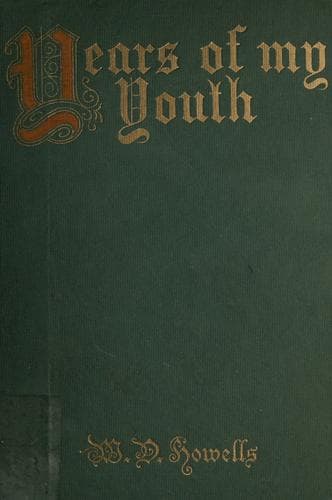
Howells, William Dean, 1837-1920 -- Childhood and youth
For me it had, and
it has, a charm which I think must have come from something like genius,
if not quite genius, in the architect, to whose daring I would like to
offer this belated praise. At any rate it was the abode of entire
satisfaction to me in those happy years between 1857 and 1860 when I
could not have wished other companionship than I had there.
There could have been no gayer table than we kept, where we made the
most of one another's jokes, and were richly personal in them, as youth
always is. The management was of the simplest, but not incompatible with
dignity, for the landlord waited upon the table himself, and whoever the
cook might be, the place was otherwise in the sole charge of an elderly
maid, with a curious defect of speech, which kept her from answering,
immediately or ultimately, any question or remark addressed to her. We
valued her for this impediment because of the pathetic legend attaching
to it, and we did not value her the less, but the more, because she was
tall and lank and uncouth of face and figure, though of a beauty in her
absolute faithfulness to her duties and the kindness beyond them which
she always showed. The legend was that in her younger if not fairer time
she had been married, and when one day her husband, suddenly killed in
an accident, was brought home to her, she tried to speak, but could not
speak, and then ever afterward could only speak after great stress, and
must often fall dumb, and go away without speaking.
[Illustration: _The Medical College at Columbus. Mr. Howells had a room
in the third story above the main entrance_]
I do not know whether we really believed in this or not, but we behaved
as if we did, and revered the silent heroine of the tragedy as if it
were unquestionably true. What kept me from trying to make it into a
poem I cannot say, but I would like to think it was that I felt it above
rather than below the verse of even the poet I meant to be. How many
rooms she had charge of I could as little say, but I am certain that
there were two of us young men in each of them. My own room-mate was a
poet, even more actual than myself, though not meaning so much as I to
be always a poet; he was reading law, and he meant to practise it, but
he had contributed two poems to the _Atlantic Monthly_ before any of
mine had been printed there. This might have been a cause of bitterness
with me; his work was certainly good enough to be a cause of bitterness,
and perhaps I was not jealous because I felt that it would be useless; I
should like to believe I was not even jealous of him for being so
largely in society before I was. Later, when we came in from our evening
calls, we sometimes read to each other, out of what books I could not
say now, but probably some poet's; certainly not our own verse: he was
too wise for that and I too shy.
Public-domain text, read in full here on John Shaqi.
Reviews
Reviews
No reviews yet
Be the first to share your thoughts on this work.
Elsewhere in the archive
Join the Discussion
Join the discussion
Sign in to leave a comment or review.
Sign InorCreate an account