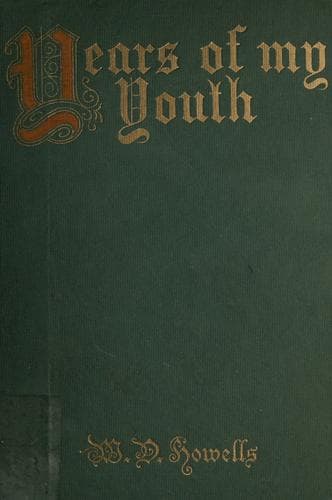
Howells, William Dean, 1837-1920 -- Childhood and youth
There was always a good deal of talk going on, but, although we were
very ardent politicians, our talk was not political. When it was not
mere banter, it was mostly literary; we disputed about authors among
ourselves and with the village wits who dropped in, and liked to stand
with their backs to our stove and challenge opinion concerning Holmes
and Poe, Irving and Macaulay, Pope and Byron, Dickens and Shakespeare.
But it was Shakespeare who was oftenest on our tongues; indeed, the
printing-office of former days had so much affinity with the theater
that compositors and comedians were almost convertible. Religion entered
a good deal into our discussions, which my father, the most tolerant of
men, would not suffer to become irreverent. Part of his duty, as
publisher of the paper, was to bear patiently with the type of farmer
who thought he wished to discontinue his paper, and really wished to be
talked into continuing it. I think he rather enjoyed letting such a
subscriber talk himself out, and carrying him from point to point in his
argument, always consenting that he knew best what he wanted to do, but
skilfully persuading him at last that a home paper was more suited to
his needs than any city substitute. Once I could have given the heads of
his reasoning, but they are gone from me now.
He was like all country editors then, and I dare say now, in being a
printer as well as an editor, and he took a just share in the mechanical
labors. These were formerly much more burdensome, for twice or thrice
the present type-setting was then done in the country offices. In that
time we had three journeymen at work and two or three girl-compositors,
and commonly a boy-apprentice besides. The paper was richer in a
personal quality, and the printing-office was unquestionably more of a
school. After we began to take girl-apprentices it became coeducative,
as far as they cared to profit by it; but I think it did not serve to
widen their thoughts or quicken their wits as it did those of the boys.
They looked to their craft as a living, not as a life, and they had no
pride in it. They did not learn the whole trade, as the journeymen had
done; but served only such apprenticeship as fitted them to set type;
and their earnings were usually as great at the end of a month as at the
end of a year.
VII
Public-domain text, read in full here on John Shaqi.
Reviews
Reviews
No reviews yet
Be the first to share your thoughts on this work.
Elsewhere in the archive
Join the Discussion
Join the discussion
Sign in to leave a comment or review.
Sign InorCreate an account