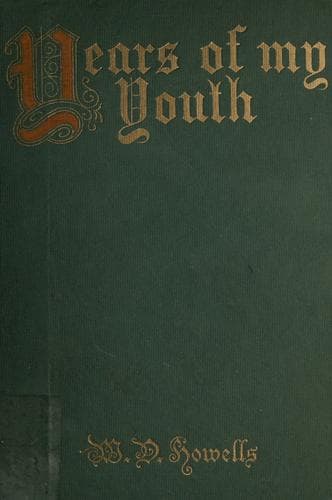
Howells, William Dean, 1837-1920 -- Childhood and youth
If my mother was the heart, he was the soul of our family life. In those
young days when he did so much of his newspaper work at home he would
always turn from it to take part in our evening jollity. He was gladly
our equal in the jokes which followed around our table; and when he was
stricken in his great age with the paralysis which he rallied from for a
time, it was his joy to join his gray-haired children at the board in
his wheeled chair and share in their laughing and making laugh. It seems
to me that I can render him intelligible by saying that while my very
religious-minded grandfather expected and humbly if fervently hoped to
reach a heaven beyond this world by means of prayers and hymns and
revivals and conversions, my not less religious-minded father lived for
a heaven on earth in his beloved and loving home; a heaven of poetry and
humor, and good-will and right thinking. He made it that sort of heaven
for himself, and as he was the bravest man I have known because he never
believed there was any danger, I think he must have felt himself as safe
from sorrow in it as if he were in the world beyond this. When one of my
younger brothers died, he was as if astonished that such a thing could
be; it burst his innocent and beautiful dream; and afterward when I
first met him, I was aware of his clinging, a broken man, to what was
left of it. Death struck again and again, and he shrank under the
bewildering blows; but a sense of that inexpressible pathos of his
first bereavement remains with me.
IX
The family scene that passed in that earlier time was not always as
idyllic as I have painted it. With five brothers in it there was often
the strife which is always openly or covertly between brothers. My elder
brother, who was four years my elder, had changed from the whimsical
tease and guardian angel of our childhood to the anxious taskmaster of
our later boyhood, requiring the same devotion in our common work that
his conscience exacted of himself. I must say that for my own part I
labored as faithfully as he, and I hotly resented his pressure. Hard
words passed between us two, as blows, not very hard, had passed, while
we were still children, between me and my younger brothers. But however
light the blows were, they had to be disclaimed, and formal regret
expressed, at my father's insistence. He would ascertain who struck the
first blow, and when he had pronounced that wrong he would ask, "And you
struck him back?" If the fact could not be denied, he went on to the
further question, "Well, do two wrongs make a right?" Clearly they did
not, and nothing remained but reluctant apology and reconciliation.
Reason and civic morality were on his side, but I could not feel that
justice was, and it seems to me yet that the primary offender was
guiltier than the secondary.
Public-domain text, read in full here on John Shaqi.
Reviews
Reviews
No reviews yet
Be the first to share your thoughts on this work.
Elsewhere in the archive
Join the Discussion
Join the discussion
Sign in to leave a comment or review.
Sign InorCreate an account