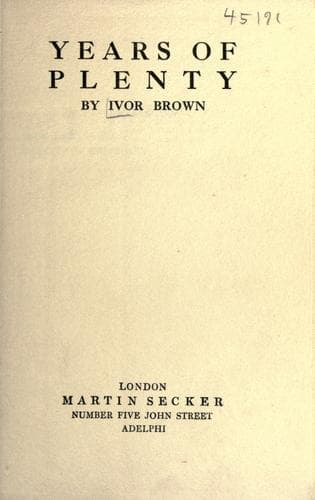
Boarding schools -- England -- Fiction; University of Oxford -- Fiction
"I enjoyed myself all the time," he said. "It was splendid!"
"That was good. And did you learn anything?"
"Nothing much from our talking. But I think I understand about the
mystery."
"I thought Paris might drive it home; it used to smell so in August.
Does it still?"
"In places." The scent of fir-trees came to him on the summer breeze.
"I do see really," he added, almost pleadingly.
"I'm glad for your own sake. It's as well to look at the future. You
may have to go to India. That may mean the end of books and talking
and ideas. But you'll get reasonable pay and occasional leave and then
you won't feel like anything but shooting and fishing. And perhaps
when you're fifty or so you'll struggle back to this kind of existence.
I assure you there's something in it all. And once you've dropped your
philosophy of this and art of that for thirty years they won't come
back. Ham and Eggs will be your only deity. But it isn't merely
carnal."
"I see that," Martin replied.
Somehow the future did not seem so ugly to Martin as he stood watching
the young moon hanging lightly over the dark shoulder of the moor. It
would be good to come back and worship the goddess in Devonshire.
"Thanks for the initiation," he said as they turned back to the house.
V
"The' being no fur' questions, much pleasure call on Mr Leigh for his
paper on Industrialism and the Home." (_Mild applause._)
The members of the King's Essay Society were scattered about Martin's
rooms, lounging in window-seats or strewn on the floor. The air was
thick with smoke, the carpet invisible by reason of the mingled feet,
tobacco, coffee-cups, books, and crystallised fruit. The Push were
present in force, and Lawrence, larger than ever, lounged on the sofa
and smoked a cigar with ungainly opulence.
Martin, from his seat by the reading-lamp, began to inform them about
the home. He started philosophically, taking as his text the assertion
that voluntary associations are always preferable to compulsory
grouping and that it should be our object to restrict such compulsion
as far as possible. The home is a compulsory association and its
sphere must be limited. He pointed out that since the whole trend of
industrialism had been to invade the home, to capture the women and to
drag them out to wage-slavery, it was irrational to stop in the present
position. The home must be either a real thing where women were free
from the direct clutches of capitalism and made up for indirect
economic dependence by freedom from drudgery in offices and factories,
or else we must be logical and complete the tendency by industrialising
the home. This process would of course destroy the home as at present
understood. But it would substitute for the present compulsory group a
voluntary association: and this he would welcome because the home of
to-day was not only a compulsory but a fundamentally rotten
institution. (_Loud applause from emancipated young men._)
Public-domain text, read in full here on John Shaqi.
Reviews
Reviews
No reviews yet
Be the first to share your thoughts on this work.
Elsewhere in the archive
Join the Discussion
Join the discussion
Sign in to leave a comment or review.
Sign InorCreate an account