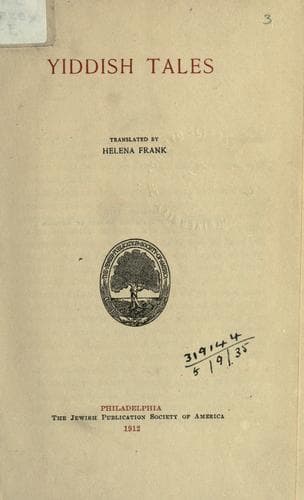
Jewish fiction; Jews -- Fiction; Short stories, Yiddish -- Translations into English
We made advances. She was very willing to become acquainted with us, and
it was not very long before she was like a mother to us, or an old aunt.
My wife was then an inexperienced "housemistress" fresh to her duties,
and found a great help in the old woman, who smilingly taught her how to
proceed with the housekeeping. When our first child was born, she took
it to her heart, and busied herself with its upbringing almost more than
the young mother. It was evident that dandling the child in her arms was
a joy to her beyond words. At such moments her eyes would brighten, her
wrinkles grew faint, a curiously satisfied smile played round her lips,
and a new note of joy came into her voice.
At first sight all this seemed quite simple, because a woman is
naturally inclined to care for little children, and it may have been so
with her to an exceptional degree, but closer examination convinced me
that here lay yet another reason; her attentions to the child, so it
seemed, awakened pleasant memories of a long-ago past, when she herself
was a young mother caring for children of her own, and looking at this
strange child had stirred a longing for those other children, further
from her eyes, but nearer to her heart, although perhaps quite unknown
to her--who perhaps existed only in her imagination.
And when we were made acquainted with the details of her life, we knew
our conjectures to be true. Her history was very simple and commonplace,
but very tragic. Perhaps the tragedy of such biographies lies in their
being so very ordinary and simple!
She lived quietly and happily with her husband for twenty years after
their marriage. They were not rich, but their little house was a kingdom
of delight, where no good thing was wanting. Their business was farming
land that belonged to a Polish nobleman, a business that knows of good
times and of bad, of fat years and lean years, years of high prices and
years of low. But on the whole it was a good business and profitable,
and it afforded them a comfortable living. Besides, they were used to
the country, they could not fancy themselves anywhere else. The very
thing that had never entered their head is just what happened. In the
beginning of the "eighties" they were obliged to leave the estate they
had farmed for ten years, because the lease was up, and the recently
promulgated "temporary laws" forbade them to renew it. This was bad for
them from a material point of view, because it left them without regular
income just when their children were growing up and expenses had
increased, but their mental distress was so great, that, for the time,
the financial side of the misfortune was thrown into the shade.
Public-domain text, read in full here on John Shaqi.
Reviews
Reviews
No reviews yet
Be the first to share your thoughts on this work.
Elsewhere in the archive
Join the Discussion
Join the discussion
Sign in to leave a comment or review.
Sign InorCreate an account