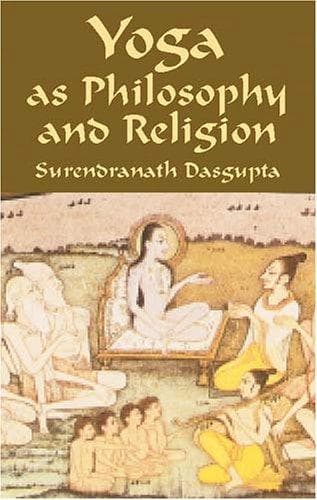
Yoga as philosophy and religionDasgupta, Surendranath
Religion
Yoga as philosophy and religion
Dasgupta, Surendranath
Hindu philosophy; Patañjali; Yoga
_Prabhākara._—Prabhākara also holds the same view; for according to him
also the letters are pronounced in a definite order; though when
individually considered they are momentary and evanescent, yet they
maintain themselves by their potency in the form of a pāda or name, and
thus signify an object. Thus Śāliknātha Miśra says in his _Prakaraṇa
Pañcikā_, p. 89: “It is reasonable to suppose that since the later
letters in a word are dependent upon the perception of a preceding one
some special change is wrought in the letters themselves which leads to
the comprehension of the meaning of a word.... It cannot be proved
either by perception or by inference that there is any word apart from
the letters; the word has thus for its constituents the letters.”
_Śabara._—The views of Kamārila and Prahhākara thus explicated are but
elaborate explanations of the view of Śabara who states the whole theory
in a single line—_pūrvavarṇajanitasaṃskārasahito’ntyo varṇaḥ
pratyāyakaḥ_.
“The last letter together with the potency generated by the preceding
letters is the cause of significance.”
_Mahābhāshya and Kaiyaṭa._—After describing the view of those who are
antagonistic to the sphoṭa theory it is necessary to mention the
Vaiākaraṇa school which is in favour of it; thus we find that in
explaining the following passage of Mahābhāshya,
“What is then a word? It is that which being pronounced one can
understand specific objects such as those (cows) which have tail, hoofs,
horns, etc.”
Kaiyata says: “The grammarians think that denotation belongs to words,
as distinct from letters which are pronounced, for if each of the
letters should denote the object, there would be no need of pronouncing
the succeeding letters....”
The vaiyakaraṇas admit the significant force of names as distinguished
from letters. For if the significant force be attributed to letters
individually, then the first letter being quite sufficient to signify
the object, the utterance of other letters becomes unnecessary; and
according to this view if it is held that each letter has the generating
power, then also they cannot do it simultaneously, since they are
uttered one after another. On the view of manifestation, also, since the
letters are manifested one after another, they cannot be collected
together in due order; if their existence in memory is sufficient, then
we should expect no difference of signification or meaning by the change
of order in the utterance of the letters; that is “_sara_” ought to have
the same meaning as “_rasa_.” So it must be admitted that the power of
signification belongs to the sphoṭa as manifested by the nādas as has
been described in detail in _Vākyapadīya_.
Public-domain text, read in full here on John Shaqi.
Reviews
Reviews
No reviews yet
Be the first to share your thoughts on this work.
Elsewhere in the archive
Join the Discussion
Join the discussion
Sign in to leave a comment or review.
Sign InorCreate an account